
Why Cashless Claims Fail And How to Prevent It
Table of Contents
Discover the top reasons why cashless claims fail and how to prevent it. Expert tips to ensure smooth hospitalization and approval.
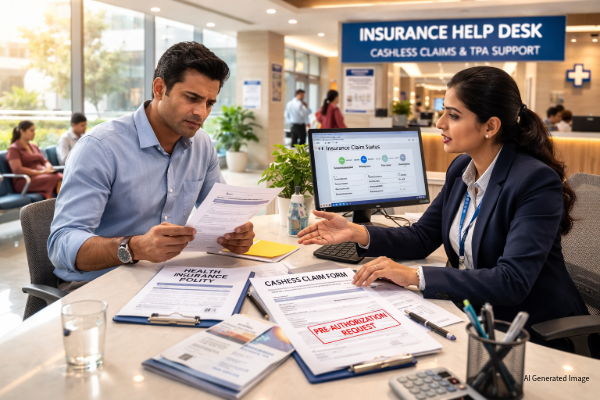
Imagine this. You are rushed to a hospital in the middle of the night. Your family is panicking. You walk up to the admission counter, hand over your health insurance card, and wait for the cashless claim to get approved.
Instead, the insurer sends a rejection.
Now you have to arrange a large sum of money on your own, during one of the worst moments of your life.
This is not a rare story. Thousands of policyholders in India face cashless health insurance claim rejections every year. And in most cases, the rejection was entirely avoidable.
The good news is that once you understand why cashless claims fail, you can take simple steps to make sure yours never does.
First, Understand How Cashless Claims Actually Work
A cashless health insurance claim means your insurance company settles the hospital bill directly. You do not have to pay from your own pocket and then wait for reimbursement.
But this system works only when specific conditions are satisfied. The hospital must be a registered network hospital under your insurer. The treatment must fall within the coverage of your health insurance policy. The policy must be active on the date of admission. And the insurer must authorize the cashless request before or within hours of the hospitalization.
These rules are governed and regulated by the Insurance Regulatory and Development Authority of India, widely known as IRDAI. The regulator ensures that both policyholders and insurance companies are protected under a transparent and fair claim process.
Skipping any one of these conditions is enough to get your cashless health insurance claim denied.
Most Common Reasons Cashless Claims Get Rejected
1. Choosing a Hospital Outside the Network
This is the most common reason cashless health insurance claims fail across India.
Every health insurance company in India maintains a list of network hospitals. These are hospitals that have a direct agreement with the insurer to process cashless requests. If you visit a hospital that is not on this list, the insurer has no arrangement to settle the bill directly.
You can still apply for a reimbursement claim afterwards, but you will have to pay the full hospital bill upfront first.
Always check your insurer’s network hospital list before a planned admission. Most insurers offer a searchable list on their website or mobile app, where you can filter hospitals by city, area, or pincode.
2. Waiting Period Is Still Active
Every health insurance policy in India comes with defined waiting periods. These are time frames during which the insurer will not cover certain treatments.
As per standard IRDAI-regulated health insurance policies, there is typically a 30-day initial waiting period from the policy start date for most illnesses. Specific conditions such as hernia, cataract, varicose veins, joint replacements, and kidney stones often carry a waiting period of 1 to 2 years. Pre-existing diseases are generally covered only after 2 to 4 years, depending on the insurer and the specific policy terms.
If you are hospitalized for a condition that falls under an active waiting period, your cashless health insurance claim will not go through.
Study your policy document carefully and note down every waiting period before you actually need to use your health cover.
3. Non-Disclosure of Existing Medical Conditions
Many people hide health conditions when applying for health insurance to keep the premium lower or to avoid detailed medical checks. This is a serious mistake.
If the insurer discovers an undisclosed condition like diabetes, hypertension, asthma, or any other pre-existing disease during claim investigation, they have every right to reject the cashless claim. In certain cases, they can even void the entire policy.
Under IRDAI regulations, insurers are permitted to investigate medical records at the time of a claim. Concealing health information is not just a risk, it is a direct violation of the terms of your insurance contract.
Always disclose your complete and accurate medical history when purchasing a health insurance policy.
4. Policy Has Expired or Lapsed
A cashless health insurance claim can only be processed when your policy is active and in force on the date of admission.
A lapsed policy means zero coverage, even for a single day. Most standard health insurance policies in India do offer a 30-day grace period for premium renewal. However, this grace period does not extend active coverage. If you are hospitalized during the grace period, your cashless claim will still be rejected.
Set a renewal reminder at least 30 days before your policy expiry date. Many insurers now offer an auto-renewal option, which is the easiest way to make sure your health insurance policy never lapses.
5. Treatment Not Covered Under Policy
Health insurance does not cover every possible medical procedure. Each policy has a defined list of exclusions.
Common exclusions across most health insurance plans in India include cosmetic or aesthetic treatments, dental procedures unless caused by an accident, weight loss or obesity surgeries, experimental treatments not approved by medical boards, and non-medical consumables like toiletries or food charges.
Some policies also have sub-limits or restrictions on room rent, specific surgeries, and day care procedures. If your treatment falls under any of these exclusions, the cashless claim will not be approved regardless of which hospital you choose.
Read the exclusions section of your health insurance policy at least once a year. It takes less than 20 minutes and can save you from a very unexpected bill.
6. Delay in Informing the Insurance Company
Most people do not realise that timelines matter a great deal in cashless health insurance claims.
For planned hospitalizations, standard health insurers in India require advance notification of at least 48 to 72 hours before admission. For emergency hospitalizations, you are typically expected to inform the insurer within 24 hours of admission.
If you delay this intimation, the insurer may flag the claim for additional scrutiny or reject the cashless request on procedural grounds alone, even if the treatment itself is fully covered.
As soon as you know a hospitalization is on the horizon, contact your insurer immediately through their helpline or mobile app to initiate the pre-authorization request.
7. Incorrect or Incomplete Information
Cashless claim approvals rely heavily on accurate and complete documentation.
If the hospital submits incorrect patient details, wrong diagnosis codes, incomplete medical records, or missing lab reports, the insurer can put the request on hold or decline it outright. These clerical errors are more common than most people expect.
Do not simply hand over your insurance card and assume the hospital will handle everything correctly. Actively coordinate with the hospital’s insurance or billing desk to confirm that the pre-authorization request has been submitted with all the required information.
Simple Steps to Ensure Your Cashless Claim Gets Approved
Before Buying Insurance
Select an insurer with a wide and regularly updated network hospital list in your city. Be honest about your full medical history during the application process. Understand all waiting periods and exclusions before purchasing the policy.
Before Hospital Admission
Confirm that the hospital is listed in your insurer’s network. Inform your insurance company about the planned admission well within the required time frame. Carry your health insurance card, a valid government-issued photo ID, and a copy of your policy document.
During Hospitalization
Ask the hospital’s insurance desk to submit the pre-authorization request at the earliest. Provide all medical records, test reports, and doctor’s notes as required. Stay in touch with the insurer’s claims helpline if there are any delays or queries.
After Approval
Review the final hospital bill carefully and understand exactly what is being covered and what is not. Keep photocopies or digital copies of your discharge summary, bills, and the authorization letter. You may need these for any future claims or tax filings.
What If Your Cashless Claim Still Gets Rejected?
Even with all the right steps in place, rejections can occasionally happen. Here is what you can do next.
Option 1: Apply for Reimbursement
Pay the hospital bill, collect all original documents including bills, prescriptions, discharge summary, and diagnostic reports, and submit a reimbursement claim to your insurer. If the treatment is covered under your policy, the insurer is obligated to pay you back.
Option 2: Request Detailed Explanation
Ask your insurer for a written explanation of the rejection. Sometimes, cashless health insurance claims are denied due to minor technical errors or missing documents that can be corrected and resubmitted. A quick clarification can reverse the decision.
Option 3: File Complaint if Necessary
If you believe the rejection is unjustified, file a formal complaint with your insurer’s grievance redressal team. If the matter is not resolved within 30 days, you can approach the IRDAI Bima Bharosa portal or the Insurance Ombudsman in your region for an independent review at no cost.
Real-Life Scenario
Consider two policyholders with the exact same health insurance coverage, same insurer, and same sum insured.
The first person verifies the network hospital list before a scheduled knee surgery. He informs the insurer 48 hours in advance, carries all his documents, and coordinates with the hospital billing desk. His cashless health insurance claim is approved smoothly. He pays nothing out of pocket.
The second person picks a hospital close to his home without checking the network status. He does not inform the insurer beforehand. The hospital turns out to be non-network. The cashless request is declined. He ends up arranging over a lakh rupees on short notice.
Same policy. Completely different outcomes. The only difference was preparation and awareness.
Quick Summary
Cashless health insurance claims most commonly fail because of a non-network hospital choice, active waiting period restrictions, policy lapse, non-disclosure of pre-existing conditions, policy exclusions, delayed insurer intimation, or incorrect documentation. Every single one of these causes is preventable with a little planning and knowledge.
Expert Advice
To ensure smooth cashless health insurance claim approval every time, buy your health insurance policy early in life when you are healthy and premiums are lower. Maintain an active policy by renewing it on time every year without fail. Always choose a network hospital for planned treatments. Keep your policy documents and health card easily accessible. And make it a habit to call your insurer the moment any hospitalization is being planned.
These are not complicated steps. But they make a decisive difference when a real medical emergency arrives.
Conclusion
Cashless health insurance is one of the most practical financial protections available to families in India. It removes the burden of arranging large amounts of money during medical emergencies and lets you focus entirely on recovery.
But the cashless facility only works as intended when you understand how it operates and what it requires from you.
Cashless claim rejections do not happen randomly. They almost always trace back to something that was within your control. With the right awareness, timely action, and a habit of reviewing your health insurance policy regularly, you can make sure your cashless claim goes through without a hitch every single time you need it.
FAQs
Why is cashless claim rejected even with active policy?
Usually due to waiting period, exclusions, or non-network hospital.