
How to Prepare Financially for Unexpected Expenses
Table of Contents
Learn how to prepare financially for unexpected expenses with proven steps, build an emergency fund, choose the right insurance, and avoid costly money mistakes.
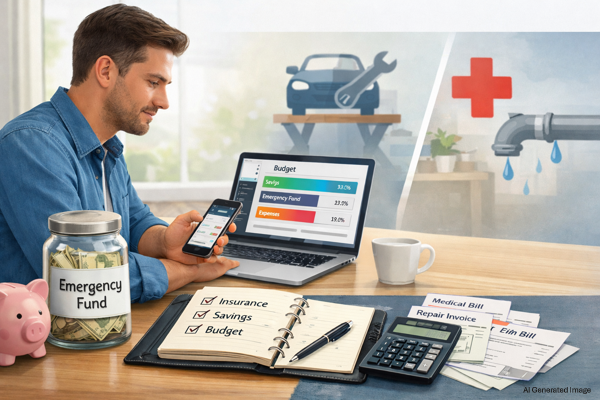
Life rarely gives you a heads-up before throwing a financial curveball at you.
One month everything is fine. The next month, your car breaks down, your child needs surgery, or your job situation changes overnight. These are not rare events. They happen to ordinary people every single day.
The question is not whether unexpected expenses will come. They will. The real question is: will you be ready when they do?
Preparing financially for unexpected expenses is not about being rich. It is about being smart with what you already earn. Let us break it down into simple, actionable steps that anyone can follow.
Why Unexpected Expenses Feel So Stressful
Here is something most people do not realize: financial stress rarely comes from spending too much on planned things. It comes from spending money you never budgeted for.
Think about it. When you book a vacation, you save for it. When you buy a new phone, you plan for it. But when the washing machine breaks down or a family member is hospitalized, there is no plan. That gap between urgency and preparation is where financial panic lives.
Four situations make unexpected expenses especially painful:
- No emergency savings to fall back on
- Over-reliance on credit cards or loans
- All investments locked in long-term or illiquid assets
- Little to no insurance coverage
When all four problems exist at the same time, even a moderate financial shock can feel like a disaster.
Step 1: Build an Emergency Fund (Your Financial Shock Absorber)
Your emergency fund is the foundation of financial preparedness. Without it, everything else becomes much harder.
So how much should you actually save?
- Minimum target: 3 months of your total monthly expenses
- Ideal target: 6 months of monthly expenses
- Freelancers and business owners: 9 to 12 months is safer
For example, if your monthly household expenses are Rs. 40,000, your emergency fund goal should be around Rs. 2.4 lakh for a six-month cushion. That number might feel large right now, but you do not build it overnight. Even saving Rs. 3,000 to Rs. 5,000 every month consistently will get you there within a few years.
Where should you keep this money? Liquidity matters more than returns here.
- A regular savings account works for instant access
- Sweep-in fixed deposits give slightly better interest without sacrificing access
- Liquid mutual funds are another option, though they carry some market risk and are not as instantly accessible as a bank account
The goal of an emergency fund is not to grow wealth. It is to protect you.
Step 2: Get the Right Insurance Coverage
Insurance is not an expense. It is a financial wall between your savings and disaster.
Major hospitalization in a private metro hospital a cardiac procedure, planned surgery, or an extended ICU stay can cost Rs. 2 to 5 lakh or more. Even routine admissions for infections, fractures, or short stays regularly run into tens of thousands of rupees. Without health insurance, that bill comes directly out of your pocket or goes on to your credit card at a crippling interest rate.
Here is what basic insurance coverage looks like for most Indians:
- Rs. 10 to 20 lakh coverage is recommended for people living in metro cities
- Rs. 5 to 10 lakh may be sufficient in smaller cities, depending on your family size and hospital preference
- Always check whether your employer-provided group cover is enough on its own. In most cases, it is not
Term Life Insurance:
- If your family depends on your income, term life insurance is non-negotiable
- A Rs. 1 crore term cover typically costs between Rs. 700 and Rs. 1,200 per month for a healthy 30-year-old
Personal Accident Cover:
- This policy is often ignored but extremely useful
- It provides income replacement if an accident leaves you temporarily or permanently unable to work
Skipping insurance to save money in the short term is one of the most expensive financial decisions you can make.
Step 3: Create a Buffer in Your Monthly Budget
Living paycheck to paycheck is financially dangerous, even if you earn a decent salary.
A good rule of thumb is to spend no more than 80 to 85 percent of your take-home income each month. The remaining 15 to 20 percent goes toward savings and investments.
This is not a rigid rule. Your income, family situation, and city of residence all affect what is realistic for you. But the principle matters. When you consistently spend less than you earn, you naturally create breathing room in your budget.
That breathing room absorbs small financial shocks like:
- An unexpected electricity bill
- A quick trip for a family emergency
- A broken appliance that needs replacing
- A medical consultation that was not planned
Small buffers prevent small problems from becoming big ones.
Step 4: Don't Lock All Your Money in Long-Term Investments
Investing is important. Nobody is arguing against that. But investing every spare rupee into long-term, locked instruments is a mistake many middle-class Indians make.
Common culprits include:
- ELSS funds with a mandatory 3-year lock-in period
- PPF accounts where withdrawals are restricted for years
- Real estate which can take months or years to convert into cash
If all your wealth is tied up in these assets and an emergency hits, you are stuck. You cannot sell a flat quickly. You cannot withdraw PPF on a Tuesday afternoon.
A smarter approach balances long-term wealth creation with short-term accessibility. As a general guideline, keeping around 20 to 30 percent of your savings in accessible or semi-liquid form gives you options when life gets unpredictable. The exact allocation depends on your age, income, and financial goals.
Step 5: Use Credit Carefully (Not as a Plan)
Let us be clear about credit cards. They are not emergency funds. They look like one, but they are not.
Credit card interest rates in India currently range between 30 and 48 percent annually, depending on the bank and card type. That means if you put a Rs. 1 lakh emergency on your credit card and take six months to repay it, you are paying significantly more than the original amount.
Smart credit use during emergencies:
- Use your credit card only after your emergency fund runs short
- Pay it off as fast as possible, even if it means cutting other expenses temporarily
- Avoid taking personal loans to handle emergencies unless absolutely necessary, since personal loan interest rates in India typically range from 10 to 24 percent annually
Think of credit as a bridge, not a destination.
Step 6: Plan for "Predictable Surprises"
Some expenses catch people off guard every single year, despite happening at the exact same time annually. That is not bad luck. That is poor planning.
Common examples in Indian households:
- Annual insurance premium renewals
- School or college fees at the start of the academic year
- Car servicing and road tax renewals
- Diwali and wedding season expenses
- Annual medical check-ups
The fix here is called a sinking fund. You set aside a small fixed amount every month specifically for these recurring big-ticket expenses. By the time the bill arrives, the money is already sitting there waiting.
For example, if your annual insurance premium is Rs. 24,000, saving Rs. 2,000 every month means you are never scrambling when renewal month comes around.
Step 7: Build Income Resilience
Preparing financially for unexpected expenses is not only about saving money. It is also about protecting your ability to earn it.
A job loss or business slowdown is one of the most financially damaging unexpected events a person can face. The more dependent you are on a single income stream, the more vulnerable you are.
Some practical ways to build income resilience:
- Develop a skill that can generate freelance or consulting income
- Explore part-time or weekend income opportunities
- Build a small online presence in your area of expertise
You do not need to run a side business full time. Even an extra Rs. 10,000 to Rs. 15,000 per month from a secondary source can meaningfully change how you handle a financial emergency.
Step 8: Review and Adjust Every Year
A financial safety net that worked for you three years ago may not be enough today.
Your expenses grow. Your family grows. India’s long-run average inflation has been around 5 to 6 percent, though recent years have brought it closer to 4 to 5 percent as the RBI targets a 4 percent inflation rate. Either way, the cost of living rises every year, which means your emergency fund target should grow accordingly.
Review these things at least once a year:
- Has your monthly expense figure gone up significantly?
- Is your health insurance sum insured still adequate given rising medical inflation?
- Does your term life cover reflect your current income and liabilities?
- Is your emergency fund still equal to at least 3 to 6 months of current expenses?
Annual reviews take less than an hour and can save you from major financial gaps.
Real-Life Example
Consider Ravi, who earns Rs. 60,000 per month in a mid-sized Indian city.
He saves Rs. 10,000 every month consistently. Over roughly two and a half years, he builds an emergency fund of Rs. 3 lakh. He also purchases a health insurance policy with Rs. 15 lakh coverage.
One year, a medical emergency costs his family Rs. 1.2 lakh. His insurance covers a large portion of it after the claim is processed. The emergency fund handles the remaining out-of-pocket costs. He takes on zero debt. His long-term investments remain completely untouched.
That is what financial preparedness actually looks like in real life.
Common Mistakes to Avoid
- Treating credit cards as your emergency fund
- Ignoring health and life insurance to save on premiums
- Investing every rupee for returns without keeping anything accessible
- Not tracking monthly expenses, so you never know your actual baseline
- Delaying the emergency fund because the amount feels too large to reach
Final Thoughts
Unexpected expenses are not a question of if. They are a question of when.
Financial confidence does not come from a high salary. It comes from preparation, consistency, and a few simple systems working together in the background.
You do not need to fix everything this week. Start with one step.
Save your first Rs. 5,000 as the seed for your emergency fund. Buy basic health insurance if you do not already have it. Start tracking your monthly spending so you know where your money actually goes.
Each small step builds on the last. And over time, what once felt like financial fragility becomes something much more solid: a life where unexpected expenses are an inconvenience, not a crisis.