
Over-Diversification Is Your Portfolio Too Spread Out (A Costly Mistake Hurting Returns)
Table of Contents
Learn how over-diversification quietly eats into your returns and discover practical ways to build a focused, high-performing investment portfolio.
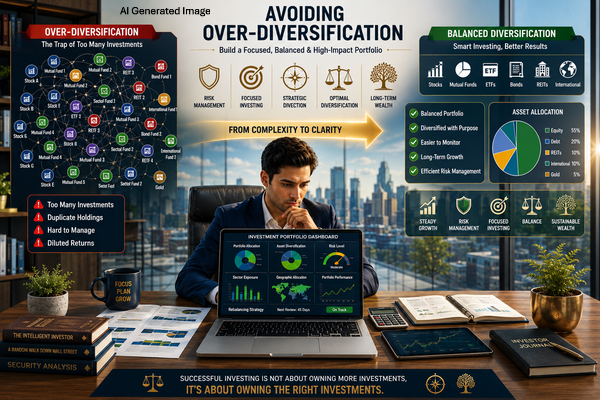
You’ve probably heard this line a hundred times. Don’t put all your eggs in one basket.
It’s solid advice. Spreading your money across different investments protects you when one of them stumbles. But somewhere along the way, many investors take this advice too far. They end up owning so many funds and stocks that their portfolio stops making sense, even to them.
This is over-diversification, and it’s more common than most people think. Let’s break down what it actually means, how it quietly drags down your returns, and what you can do to fix it.
What Over-Diversification Really Means
Over-diversification happens when you own so many investments that adding one more barely changes your risk. At that point, you’re not protecting your money anymore. You’re just adding clutter.
Picture a chef seasoning a dish. A pinch of salt and a dash of pepper make it delicious. Dump in ten different spices and the flavour disappears. Your portfolio works the same way. A few well-chosen investments create balance. Too many, and the whole thing turns bland and confusing.
This isn’t just a theory. Regulators have noticed the same pattern. SEBI has tightened its mutual fund classification rules to curb exactly this kind of overcrowding, raising minimum equity exposure requirements for large-cap funds and introducing stricter overlap norms so that different schemes stop looking like copies of each other. If regulators feel the need to step in and limit overlap, it’s a strong sign that over-diversification is a real, measurable drag on investor outcomes, not just a hypothetical risk.
Why We Diversify in the First Place
Before pointing out the problem, it’s worth remembering why diversification exists at all.
No single asset performs well all the time. Equities might rally while gold sits quiet. Debt instruments hold steady when stock markets turn volatile. By spreading your money across asset classes such as equity, debt, gold and cash, you reduce the impact of any one investment having a bad year.
That’s healthy diversification. It’s about managing risk, not chasing every opportunity that crosses your feed.
Signs You've Crossed the Line
Over-diversification tends to creep in slowly. Here’s how to spot it.
- You own four or five large-cap funds that quietly hold the same top companies
- Your stock list has grown past 30 names and you can’t recall why you bought half of them
- Reviewing your portfolio takes an entire weekend instead of an hour
- Your returns barely beat a plain index fund despite all the extra effort
- You bought something because a friend or a finance influencer recommended it, not because it fit your plan
If several of these sound familiar, your portfolio isn’t more protected. It’s just harder to manage.
The Real Cost of Owning Too Much
You dilute your winners. When one strong stock or fund is buried among 60 others, its impact on your overall wealth shrinks to almost nothing, even if it doubles in value.
You pay more without realising it. Every fund carries an expense ratio, and every trade adds brokerage and transaction costs. A cluttered portfolio quietly nibbles away at your returns through fees you barely notice.
You create duplicate risk instead of reducing it. Many mutual funds, especially large-cap ones, hold overlapping stocks. Owning several such funds feels like diversification, but you’re often buying the same companies again and again under different fund names.
You invite decision fatigue. More holdings mean more decisions. Should you sell this fund? Add to that stock? Rebalance again? Eventually, many investors just stop reviewing their portfolios altogether, which defeats the entire purpose of investing with a plan.
Why This Happens to Even Smart Investors
Over-diversification rarely happens on purpose. It sneaks up through a few common habits.
Fear of missing out pushes people to add every trending stock or thematic fund, just in case it takes off.
Lack of a clear plan makes every recommendation sound reasonable, because there’s no yardstick to measure it against.
Chasing past winners leads investors to buy funds only after they’ve already delivered strong returns, often duplicating exposure they already have.
Confusing quantity with safety is perhaps the biggest trap. Owning 50 investments doesn’t automatically make you safer than owning 12 carefully chosen ones. What matters is how well those investments work together, not how many you hold.
How to Simplify Without Taking on More Risk
Get clear on your goals first. Every investment in your portfolio should tie back to something specific, whether that’s retirement, a house down payment, your child’s education, or simply building long-term wealth. If a holding doesn’t connect to a goal, question why it’s there.
Audit your existing investments. Before buying anything new, check what you already own. Look at the top holdings of your mutual funds. You might discover that three of your “different” funds are really just one fund wearing different labels.
Aim for a manageable number, not a maximum one. There’s no magic figure that works for everyone, but a thoughtfully built mix of a handful of diversified funds, a few carefully picked stocks, and some fixed-income exposure usually covers what most individual investors need. The goal is coverage, not accumulation.
Review twice a year, not every day. Set a fixed schedule to check your portfolio, trim overlap, rebalance if your allocation has drifted, and replace anything that no longer fits your strategy. Avoid reacting to daily market noise.
Let asset allocation do the heavy lifting. Long-term results are shaped far more by how your money is split between equity, debt, gold and cash than by how many individual products you own. Get that balance right and you won’t need dozens of holdings to feel diversified.
A Quick Comparison
Imagine two investors with similar wealth. The first owns 40 mutual funds, 70 stocks and a handful of ETFs, most of them overlapping. Reviewing this portfolio eats up an entire weekend, and half the holdings barely move the needle.
The second owns three diversified mutual funds, eight researched stocks, one debt fund and some gold. A quarterly check takes about an hour.
Both investors are diversified. Only one of them can actually explain, in one sentence, why they own what they own. That clarity, more than the sheer number of holdings, is what protects wealth over the long run.
Final Thoughts
Diversification is meant to simplify risk, not multiply your workload. Once you cross a certain point, adding more investments stops protecting you and starts diluting your gains, inflating your costs, and draining your time.
You don’t need a massive portfolio to be a serious investor. You need one you understand, one that’s tied to your actual goals, and one you can review without dreading it. Sometimes the smartest move isn’t adding another fund. It’s finally letting a few unnecessary ones go.
FAQs
What is over-diversification in investing?
Over-diversification occurs when you own so many investments that adding more provides little or no additional risk reduction while increasing complexity and potentially diluting returns.
How many mutual funds should I own?
There is no fixed number for everyone. Many investors can achieve broad diversification with a small number of well-chosen funds, provided they align with their financial goals and asset allocation.
Can over-diversification reduce returns?
Yes. If your portfolio contains many overlapping investments, strong performers may have less impact on overall returns, and managing the portfolio may become more difficult.
How often should I review my portfolio?
A review once or twice a year is sufficient for most long-term investors. Additional reviews may be appropriate after major life events or significant changes to your financial goals.
Is diversification still important?
Absolutely. Diversification remains one of the most effective ways to manage investment risk. The objective is to diversify thoughtfully rather than accumulate investments without a clear purpose.
Disclaimer
This article is for educational and informational purposes only and should not be considered financial, investment, tax, or legal advice. Please consult a qualified financial advisor before making any financial decisions.