
Does Your Company Health Insurance Provide Enough Coverage?
Table of Contents
Discover why company health insurance alone isn’t enough. Expert insights on coverage gaps, medical costs, and how to protect your family with the right health insurance strategy.
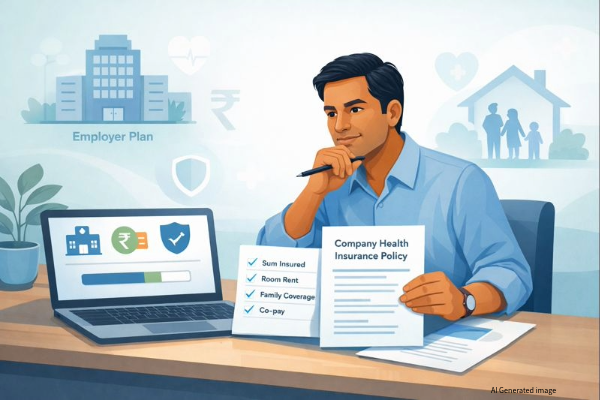
There’s something comforting about company health insurance, isn’t there. It appears on your offer letter as a shiny employee benefit, costs you nothing out of pocket, and gives you that warm feeling of being covered. Your employer takes care of it, so you are protected, right?
Well, not exactly.
Here’s what I have learned after years of advising families on health insurance. most people discover their company health insurance falls short precisely when they need it most during a medical emergency. And that’s a terrible time to realize you are underinsured.
I am not here to scare you. I am here to help you understand the reality of employer provided health coverage and, more importantly, show you how to truly protect yourself and your family.
What Exactly Is Company Health Insurance?
Let’s start with the basics. Company health insurance technically called group health insurance is a policy your employer purchases to cover employees and often their immediate family members. It’s part of your benefits package, sitting right there alongside your provident fund and leave entitlements.
The typical corporate health insurance policy includes some genuinely attractive features. You don’t pay premiums directly. There are no medical examinations required before you are covered. Pre-existing conditions are covered from day one, which is actually quite valuable. Most companies offer coverage ranging from ₹2 lakh to ₹5 lakh, though some generous employers provide more.
Sounds pretty comprehensive, doesn’t it. On paper, absolutely. In practice, there are several significant gaps that could leave you financially exposed.
Why Company Health Insurance Falls Short
1. The Coverage Amount Doesn’t Match Today’s Medical Costs
Medical inflation in India isn’t just rising it’s skyrocketing at roughly 12-14% every year. That ₹5 lakh coverage your company provides. It felt adequate maybe five or six years ago. Today, it’s a different story entirely.
Let me give you some real-world numbers from hospitals across metro cities. A standard ICU stay lasting just three to four days will set you back anywhere between ₹2 lakh to ₹3 lakh. Need heart surgery? You are looking at ₹4 lakh to ₹7 lakh, sometimes more depending on the hospital and procedure complexity. And cancer treatment God forbid anyone needs it can cost ₹8 lakh to ₹15 lakh in just the first year alone.
Think about that for a moment. One serious health crisis, and your entire company health insurance coverage evaporates. What happens to the remaining treatment costs. They come straight out of your savings, or worse, you start borrowing money when you should be focusing on recovery.
2. Your Coverage Vanishes the Moment You Leave Your Job
This is the elephant in the room that nobody talks about during those exciting offer letter discussions. Your company health insurance is tied directly to your employment status. The day you are no longer an employee, your coverage ends. Period.
Consider these common scenarios. You decide to switch companies for better opportunities. You take a sabbatical to pursue higher education or spend time with family. You reach retirement age. Or perhaps and this happens more often than we’d like to admit you face unexpected job loss during economic downturns.
In every single one of these situations, you are suddenly without health coverage at the exact moment when you might need it most. And here’s the kicker. trying to buy individual health insurance after you have developed health issues is exponentially more expensive. Some conditions might even make you uninsurable with certain policies.
3. You Have Zero Control Over Your Policy
With company health insurance, you are essentially a passive passenger. Your employer picks the insurance company. They negotiate the terms. They decide what’s covered and what isn’t. And here’s something that catches many people off guard these terms can change every single year when the policy renews.
Your employer might switch insurers entirely, looking for better rates. Sub-limits might suddenly appear on specific treatments or procedures. Room rent caps could be introduced, meaning if you need a private room during hospitalization, you might end up paying the difference yourself. Disease-specific limits might restrict how much you can claim for particular illnesses.
You discover all these changes only when you need to make a claim. It’s their policy, not yours, and that distinction matters tremendously.
4. Family Coverage Often Has Serious Limitations
Many corporate health insurance policies offer family coverage, but look closely at the fine print. Often, it’s a shared sum insured, meaning your ₹5 lakh coverage has to stretch across you, your spouse, and your children. If one family member needs major treatment, everyone else’s coverage is reduced or exhausted.
Coverage for parents is frequently inadequate or absent altogether. If your parents are included, they usually get lower coverage limits. Maternity benefits might have waiting periods or caps. OPD treatments those routine doctor visits and diagnostic tests might not be covered. Daycare procedures could be excluded.
If your parents are aging or already have medical conditions like diabetes or hypertension, relying solely on employer insurance is genuinely risky. Senior citizens need robust coverage, and company policies typically don’t provide it.
5. The Unspoken Impact of Claims on Your Professional Life
Nobody will tell you this directly, but it’s worth understanding. When employees make large or frequent health insurance claims, it increases the overall premium costs for the group policy. Insurance companies track these numbers closely.
This can have subtle but real consequences. Policy renewal terms might become less favorable for everyone. Coverage amounts might be reduced in subsequent years. And while your employer shouldn’t and likely won’t discriminate based on your health claims, the increased cost burden can create uncomfortable dynamics during performance reviews or organizational restructuring.
Having your own personal health insurance policy keeps your medical needs completely private and separate from your professional life. Your health challenges should never intersect with your career trajectory.
When Company Health Insurance Actually Helps
I don’t want to completely dismiss employer provided health insurance it does serve valuable purposes. It offers excellent initial coverage, especially when you’re young and just starting your career. The immediate coverage of pre-existing conditions is genuinely beneficial. It’s extremely useful for smaller hospitalizations, routine procedures, and sometimes OPD claims depending on your policy.
Think of company health insurance as a valuable supplementary benefit rather than your complete health coverage solution. It works brilliantly as a second layer of protection over your primary personal health insurance.
The Intelligent Approach: Building Complete Coverage
Here’s what financially savvy professionals actually do—they don’t choose between company and personal health insurance. They use both strategically.
Keep your company health insurance active. Use it as your first line of defense for medical expenses. Take full advantage of this employee benefit.
Purchase a comprehensive personal health insurance policy. Aim for minimum coverage of ₹10 lakh to ₹15 lakh. Choose a policy with lifetime renewability, ensuring you’re never left without coverage. This policy belongs to you completely, independent of your employment status.
Use company coverage first, personal coverage second. When hospitalization occurs, make your claim through your employer insurance first. If costs exceed that coverage, your personal policy covers the remaining expenses. This approach minimizes out-of-pocket spending while preserving your no-claim bonus on your personal policy, which reduces future premiums.
Determining Your Actual Health Insurance Needs
How much personal health insurance coverage do you genuinely need. Here’s a practical framework for Indian families:
If you are single and under 35, start with at least ₹10 lakh coverage. For married couples, consider a ₹15-20 lakh floater policy covering both partners. When parents are involved, purchase separate senior citizen health insurance policies specifically designed for their age group and health needs.
Your specific coverage requirements depend on several factors your city’s medical costs, your family’s medical history, existing health conditions, and your lifestyle. Metro cities typically have higher hospitalization costs than tier-2 cities.
Debunking Common Health Insurance Myths
“My company provides ₹10 lakh coverage, so I am completely protected.”
Coverage today guarantees nothing about tomorrow. Job changes, company policy modifications, and retirement all put this coverage at risk.
“I’ll purchase health insurance when I actually need it.” This backwards thinking costs people lakhs. Health insurance is cheapest and easiest to obtain before you develop health problems. Once you need it, getting comprehensive affordable coverage becomes difficult or impossible.
“I am young and healthy, so personal insurance isn’t necessary right now.” Youth is precisely when you should buy health insurance. You lock in low premiums for life. You face fewer policy exclusions. You build a long claim-free history that earns you bonuses and benefits.
The Bottom Line: Is Company Health Insurance Sufficient?
Let me be direct: No, company health insurance alone is not enough for long-term financial security.
Your employer-provided health insurance is a valuable benefit that you should absolutely utilize. But treating it as your complete health coverage solution is like driving long distances on a spare tire it might work temporarily, but it’s not designed for the journey ahead.
If you want genuine financial security, medical independence regardless of employment status, and complete peace of mind for your entire family, personal health insurance is absolutely non-negotiable.
Conclusion
Buy your personal health insurance policy while you are healthy, currently employed, and easily insurable. Don’t wait for warning signs. Don’t postpone it for next year’s bonus. Don’t assume your youth protects you.
That single decision made today, while you are well can save you lakhs of rupees and countless sleepless nights filled with financial worry during medical emergencies. Your future self will thank you for the foresight and protection you provided.
Health insurance isn’t about pessimism. It’s about intelligent preparation. And preparation, done right, means combining your company health insurance with robust personal coverage that truly protects you and everyone you love.
FAQs
Is company health insurance enough for medical emergencies?
What happens to my company health insurance if I leave my job?
Should I buy personal health insurance if I already have employer coverage?
Does company health insurance cover pre-existing diseases?
Most company health insurance policies cover pre-existing diseases from day one. However, once you leave the organization, this benefit ends. Personal health insurance policies usually have waiting periods, which is why buying early is important.