
How to Choose Mutual Funds Based on Your Goal
Discover a step-by-step approach how to choose mutual funds based on your goal. Why choosing mutual funds based on goals beats chasing returns.
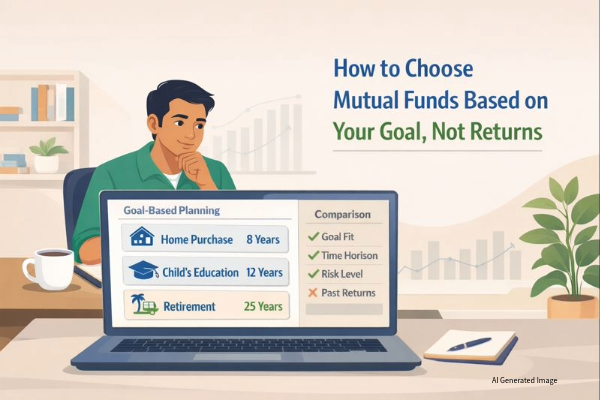
I’ve seen it happen countless times. Someone walks into my office excited about a mutual fund that returned 25% last year. Their eyes light up as they show me the performance chart. “This is the one I want to invest in,” they say confidently.
And then I ask them a simple question: “What are you investing for?”
The room goes silent.
Most investors start their mutual fund journey by looking at one thing past returns. A fund that delivered 25% last year instantly feels attractive. But here’s what two decades of working with investors has taught me great returns without a clear goal often lead to poor financial outcomes.
Think about it. You wouldn’t use a hammer to fix a leaking pipe, would you? Similarly, mutual funds are not lottery tickets. They are financial tools designed to help you achieve specific life goals buying a home, funding your child’s education, or retiring comfortably. Choosing funds based on your goal first, rather than recent performance, dramatically improves your chances of success.
Let me share a practical, goal-based approach that actually works.
Why Returns Alone Are a Misleading Metric
Past returns show what a fund has done, not what it will do. I know that sounds obvious, but we all fall for this trap.
Here’s why relying only on returns is risky:
Top-performing funds keep changing every year. The fund that topped the charts this year might be in the bottom quartile next year. Consistency matters more than occasional brilliance.
High-return funds often come with high volatility. That 25% return might have come with a stomach-churning 40% fall at some point. Can you handle that?
A fund suitable for a 25-year-old may be dangerous for a 55-year-old. Time horizon changes everything. When you are young, you can recover from market crashes. When retirement is five years away, you can’t afford to take that risk.
Here’s something that surprises people: two investors can earn the same return, yet one succeeds while the other fails simply because their time horizon and risk tolerance were different.
The smarter question isn’t “Which fund gave the highest returns?” It’s “Which fund fits my goal and timeline?”
Step 1: Clearly Define Your Financial Goal
Before selecting any mutual fund, grab a pen and paper. Write down:
- What is the goal? (retirement, house, child education, travel, emergency, etc.)
- When will you need the money?
- How much will you need (adjusted for inflation)?
Be specific. Don’t just say “I want to save for retirement.” Say “I want to accumulate ₹3 crores by the time I’m 60, which is 25 years from now.”
Examples of Common Goals
Emergency fund (0–2 years): You need this money to be accessible and stable.
Car or vacation (2–4 years): Medium-term savings with moderate growth expectations.
Child education (8–15 years): Long-term goal requiring inflation-beating returns.
Retirement (20+ years): Your longest goal, where equity can truly work its magic.
Your time horizon determines the type of mutual fund you should consider. This is non-negotiable.
Step 2: Match Your Goal With the Right Fund Category
Different fund categories serve different purposes. Using the wrong one is like trying to cut vegetables with a screwdriver technically possible, but why would you?
Short-Term Goals (0–3 Years)
Best suited fund types:
- Liquid funds
- Ultra short duration funds
- Low-duration debt funds
Why these work: These funds aim for stability and capital protection rather than high growth. You get moderate returns, but more importantly, your money stays safe when you need it urgently.
Avoid this: Never put money you’ll need in two years into equity funds. Market volatility can wipe out gains exactly when you need the money. I’ve seen investors delay their home down payment by three years because their “short-term” equity investment crashed.
Medium-Term Goals (3–7 Years)
Best suited fund types:
- Hybrid funds (equity + debt combination)
- Conservative hybrid funds
- Equity savings funds
Why these work: They offer a balance between growth and stability. The debt portion provides cushioning while the equity portion delivers growth. Think of it as wearing both a belt and suspenders you are protected, but you are also making progress.
Long-Term Goals (7+ Years)
Best suited fund types:
- Flexi-cap funds
- Large-cap funds
- Index funds
- ELSS (for tax-saving goals)
Why these work: Equity has historically delivered better inflation-beating returns over long periods. When you have time on your side, you can ride out market volatility and capture the full potential of equity markets.
Step 3: Assess Your Risk Tolerance Honestly
Risk tolerance is deeply personal. I’ve met entrepreneurs who panic at 10% portfolio declines and government employees comfortable with 30% drops.
Ask yourself honestly:
- Can I stay invested if my portfolio falls 25%?
- Will I panic and stop SIPs during market crashes?
- Does seeing my portfolio in red affect my sleep or productivity?
Simple Rule:
Low risk tolerance → More debt and hybrid funds
Moderate risk tolerance → Balanced mix of equity and debt
High risk tolerance → Higher equity exposure
Choosing a fund that makes you lose sleep is a mistake even if it delivers high returns. Financial planning should reduce stress, not create it.
Step 4: Focus on Consistency, Not Top Rankings
Instead of chasing last year’s best performer, look for funds that:
- Beat their benchmark consistently (not just occasionally)
- Perform well across different market cycles
- Have reasonable volatility for their category
A fund delivering steady 12–14% over long periods is often better than one swinging wildly between 5% and 30%. The tortoise really does beat the hare in investing.
Step 5: Evaluate the Fund Manager and AMC Track Record
Strong management matters tremendously.
Check these factors:
- Fund manager’s experience (at least 5 years preferred)
- How long they’ve managed this specific fund
- The AMC’s (Asset Management Company) overall reputation
Frequent fund manager changes can affect strategy consistency. It’s like having a different pilot every hour on a long flight unsettling and potentially risky.
Step 6: Watch the Expense Ratio
The expense ratio directly reduces your returns. Every rupee paid in fees is a rupee that’s not compounding for you.
Lower-cost funds leave more money working for you over time. A 1% difference in expense ratio might seem small, but over 20 years, it can cost you lakhs.
Index funds and ETFs generally have lower expense ratios compared to actively managed funds. If an active fund charges higher fees, it should justify them with better performance.
Step 7: Align Investment Style With Your Behaviour
Some investors prefer passive investing through index funds. Others want active management. There’s no universally “better” style only what suits your temperament and philosophy.
What matters more than style is consistency. An average investment strategy followed consistently beats a brilliant strategy that you abandon halfway.
Step 8: Use SIPs to Stay Disciplined
Systematic Investment Plans are your best friend for long-term goals.
SIPs help you:
- Reduce timing risk (you are not trying to guess market tops and bottoms)
- Build the habit of investing regularly
- Benefit from rupee cost averaging
SIPs are especially powerful for long-term goals like retirement and child education. They automate discipline, which is harder than it sounds.
Step 9: Review, Don't Overreact
Review your mutual fund portfolio:
- Once or twice a year
- When your goal timeline changes
- When a fund consistently underperforms its benchmark for 2-3 years
Avoid frequent switching based on short-term performance. Every switch has tax implications and transaction costs. Plus, you often end up buying high and selling low exactly the opposite of what creates wealth.
A Simple Goal-Based Example
Let’s make this concrete.
Goal: Child education in 12 years
Risk profile: Moderate
Possible approach:
- 70% in flexi-cap or index funds (growth engine)
- 20% in large-cap funds (stability)
- 10% in short-duration debt funds (emergency cushion)
As the goal approaches (say, 3-4 years before you need the money), gradually shift money from equity to debt. This process is called asset allocation and rebalancing—it’s a cornerstone of successful investing.
Common Mistakes to Avoid
Stop making these errors that I see repeatedly:
- Buying funds based only on last year’s returns
- Investing without a clear goal or timeline
- Ignoring proper asset allocation
- Stopping SIPs during market falls (the worst possible time)
- Copying your friend’s or relative’s portfolio without understanding your own goals
Final Thoughts
Mutual fund success is not about finding the hottest fund or timing the market perfectly.
It’s about: Right fund + Right goal + Right time horizon + Right behavior
When you invest with clarity of purpose, market ups and downs become easier to handle and your chances of achieving life goals rise dramatically.
Think of it this way: if you are driving to Mumbai from Delhi, you don’t keep changing routes based on every traffic update. You have a destination, you’ve chosen the right vehicle, and you stay on course despite minor delays.
Your investments deserve the same strategic approach.
If you are unsure how to map your goals to the right funds, consider speaking with a qualified financial advisor who follows a goal-based planning approach. The right guidance early can save you years of mistakes and missed opportunities.
Remember, investing is a marathon, not a sprint. Choose your funds wisely, stay disciplined, and let compounding work its magic.