
Why Indian Families Are Under-Insured
Table of Contents
Why most Indian families remain dangerously under-insured despite rising incomes. Learn 8 critical reasons and how to protect your family from financial catastrophe.
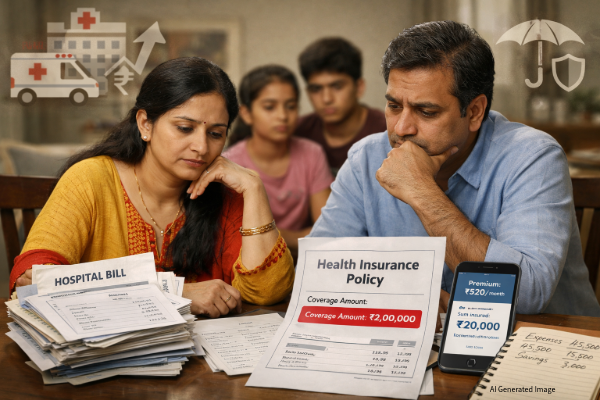
Walk into any Indian household, and you’ll likely meet financially responsible people. They maintain emergency savings, religiously invest in fixed deposits, purchase gold during festivals, and proudly mention their life insurance policies bought years back. Everything appears perfectly fine on the surface.
But here’s the uncomfortable truth when medical emergencies strike, when accidents happen, or when the primary breadwinner suddenly cannot work, these same families discover something devastating. Their insurance coverage falls painfully short. The safety net they believed in simply wasn’t strong enough to catch them.
Under-insurance has become one of India’s most dangerous silent financial killers. It doesn’t send warning signals. It doesn’t knock on your door. It just waits quietly in the shadows until crisis hits, and by then, it’s already too late to fix things.
Despite growing awareness about financial planning and steadily rising household incomes across urban and semi-urban India, millions of families remain severely under-insured. The question isn’t whether Indians care about their finances they clearly do. The real question is: why does this protection gap exist, and what’s stopping families from getting adequate insurance coverage?
Let’s break down the real reasons behind this widespread under-insurance problem affecting Indian households today.
1. Insurance Is Still Seen as an "Expense," Not Protection
Here’s something I’ve noticed after counseling hundreds of families about their finances. People have absolutely no hesitation spending money on things they value. They’ll happily commit to:
- Car and home loan EMIs running into thousands each month
- Premium school fees for children’s education
- Elaborate wedding functions and festival celebrations
- Annual family vacations and weekend getaways
- Latest smartphones and home appliances
But mention increasing their insurance premium, even by a modest amount, and suddenly everyone becomes budget-conscious. The insurance premium gets labeled as an “unnecessary expense” that should be minimized.
This fundamental mindset problem creates serious consequences. Families end up choosing the absolute cheapest policy available, avoiding adequate coverage amounts, and delaying necessary upgrades even when their income substantially increases.
The result? They carry policies that look impressive on paper but completely fail during actual emergencies when protection matters most. Insurance isn’t an expense you are throwing away it’s protection you are buying for your family’s future financial stability.
2. Heavy Dependence on Employer-Provided Insurance
This might be the single biggest reason why salaried Indians remain dangerously under-insured. I’ve lost count of how many times I’ve heard people confidently declare: “Why should I buy additional health insurance? My company already provides coverage.”
Let’s examine the reality of corporate health insurance:
- Most employer-provided health covers range between ₹3 to 5 lakh
- This coverage often shrinks significantly or completely disappears when you change jobs
- Family floater limits get shared across all members, reducing individual protection
- Coverage typically ends the moment you retire or leave employment
Now consider actual healthcare costs in Indian metros today. A serious illness requiring surgery, ICU admission, and prolonged hospitalization easily crosses ₹8 to 10 lakh. Cancer treatment, cardiac surgery, or organ transplants can demand ₹15 to 25 lakh or even more.
Relying solely on employer insurance is like carrying a small umbrella during a thunderstorm. It provides some shelter, but nowhere near enough when the real downpour hits. Your company’s health cover should be considered supplementary protection, never your primary insurance strategy.
3. Outdated Life Insurance Purchased Years Ago
I meet families who proudly announce they “already have life insurance” as if that checkbox is permanently ticked. When I ask them to share policy details, here’s what typically emerges:
- Policies purchased 10 to 15 years ago, often right after marriage
- Coverage amounts stuck at ₹10 to 20 lakh that haven’t increased since
- Income has doubled or tripled, but insurance coverage remains frozen
- New financial responsibilities added, but protection never upgraded
Here’s what most people forget inflation doesn’t spare your insurance coverage. The purchasing power of money constantly declines. That ₹20 lakh coverage that felt substantial back in 2010 barely covers two years of household expenses today for most middle-class families.
Your income grew. Your lifestyle improved. Your responsibilities multiplied. But did your insurance coverage keep pace? For most Indian families, the honest answer is no. This creates a dangerous protection gap that widens silently every passing year.
4. Confusion Between Investment and Insurance
This confusion has caused more financial damage to Indian families than perhaps any other mistake. Traditional insurance policies get aggressively sold as:
- “Guaranteed return products”
- “Tax-saving investment options”
- “Safe long-term wealth builders”
- “Best of both worlds—protection plus returns”
Insurance agents earn attractive commissions on these hybrid products, so they naturally push them hard. Families buy these policies thinking they’re getting excellent insurance coverage along with investment growth.
The reality is quite different. These insurance-cum-investment products typically provide very low risk coverage relative to the premium amount you pay. Your money gets locked up for decades, earning mediocre returns that barely beat inflation.
Meanwhile, actual financial protection remains dangerously weak. Families believe they’re comprehensively insured because they’re paying substantial premiums, but actual coverage falls far short of what their dependents would need during a crisis.
Insurance should primarily protect your family, not perform as an investment vehicle. Keep these purposes separate. Buy pure term insurance for maximum coverage at minimum cost, and handle investments separately through proper financial instruments.
5. Medical Inflation Is Grossly Underestimated
Ask most people about inflation, and they’ll mention rising prices of groceries, petrol, or housing. Very few understand that medical inflation in India runs significantly higher than general inflation.
Healthcare costs have been climbing at approximately 10-15% annually. What does this mean practically? Let me break it down:
- ICU charges that were ₹5,000 per day five years ago now cost ₹12,000 or more
- Bypass surgery that cost ₹3 lakh now demands ₹6 to 8 lakh
- Cancer treatment expenses have nearly doubled in just the past five years
- Post-hospitalization recovery costs, medicines, and income loss add another substantial burden
That ₹5 lakh health insurance you bought in 2020 thinking it was adequate? Today, it might barely cover a single hospitalization for a serious illness. Medical inflation doesn’t care about your budget it keeps rising regardless.
Many families don’t account for these rising costs until they actually receive a hospital bill. By then, it’s too late to increase coverage. The time to upgrade your health insurance is before you need it, not after diagnosis.
6. "Nothing Has Happened So Far" Mindset
Indians are naturally optimistic people. This optimism serves us well in many areas of life. But when it comes to insurance planning, optimism becomes a dangerous liability.
I constantly hear variations of these thoughts:
- “We’ve never had any major illness in our family”
- “Our family has strong genes and good health”
- “God has always protected us, why worry unnecessarily?”
- “I’m young and healthy, I’ll buy insurance later”
This optimism bias creates a false sense of security. People assess future risks based entirely on past experience, which is fundamentally flawed logic. Insurance exists precisely because we cannot predict when problems will occur.
The challenge with insurance is that you must buy it before you need it. Once you develop a serious health condition, getting coverage becomes exponentially more expensive or completely impossible. Waiting until something happens is not a strategy—it’s gambling with your family’s financial security.
7. Lack of Regular Insurance Reviews
Most Indian families review their mutual fund portfolios, check fixed deposit rates, and track gold prices regularly. But when did you last review your insurance coverage? For most people, the answer is “never” or “when I bought it years ago.”
Life doesn’t remain static. Major changes that demand increased insurance coverage include:
- Getting married and taking responsibility for a spouse
- Birth of children and their future education needs
- Taking on home loans or other significant debt
- Substantial increase in annual income and lifestyle
- Aging parents becoming financially dependent on you
- Starting a business or becoming self-employed
Each of these life events should trigger an immediate insurance review. Without periodic assessment, families unknowingly remain under-insured even as their financial responsibilities keep multiplying.
Insurance isn’t something you buy once and forget about. It requires regular maintenance and upgrades, just like any other important aspect of your financial life.
8. Fear of High Premiums
Here’s a common objection I encounter: “Adequate insurance coverage means paying huge premiums I cannot afford.”
This belief stops many families from even exploring proper insurance options. The reality couldn’t be more different:
- Term insurance provides coverage of ₹1 crore for just ₹10,000-15,000 annual premium for young, healthy individuals
- Health insurance bought at age 25-30 costs a fraction of what you’d pay at age 45-50
- Comprehensive family floater plans are available at reasonable costs when purchased early
- Annual premiums are minuscule compared to the financial devastation of being uninsured
The irony is striking. People avoid insurance to “save money” on premiums, then end up spending ten times more when emergencies strike. They break fixed deposits meant for children’s education, sell family gold accumulated over years, borrow money at crushing interest rates, or worse compromise on treatment quality to save costs.
Which scenario sounds more expensive to you paying ₹20,000 annually for comprehensive coverage, or paying ₹15 lakh from savings during a medical emergency?
The Real Cost of Being Under-Insured
Under-insurance doesn’t just drain your bank account it destroys your family’s dignity, peace of mind, and long-term financial stability during already stressful situations.
When inadequate insurance coverage fails families during crisis, they’re forced into heartbreaking situations:
- Breaking fixed deposits set aside for children’s higher education
- Selling jewelry and gold that carries emotional family significance
- Liquidating long-term investments at unfavorable times, destroying retirement plans
- Borrowing from relatives and friends, creating awkward dependencies
- Taking personal loans at 14-18% interest rates, creating debt cycles
- Crowdfunding on social media, exposing private hardships publicly
- Compromising on treatment quality and hospital choices to reduce costs
These aren’t abstract scenarios they happen to thousands of Indian families every single day. I’ve personally witnessed the emotional toll this takes. The guilt, the helplessness, the shame of asking others for financial help during vulnerable moments these psychological costs far exceed monetary losses.
No family should face these impossible choices during medical emergencies or after losing their primary breadwinner. That’s exactly what insurance exists to prevent.
Final Thoughts: Awareness Is Not Enough—Action Is Needed
Indian families aren’t careless or irresponsible about finances. Far from it. They’re among the world’s highest savers, demonstrating remarkable financial discipline in many ways.
The problem isn’t lack of concern it’s being under-prepared despite good intentions.
Effective insurance protection requires three essential elements:
Adequacy: Coverage must be sufficient for actual needs, not just minimally acceptable amounts that look good on paper.
Regular Review: Life changes constantly, and your insurance must evolve accordingly through annual assessments.
Realistic Risk Assessment: Align your coverage with genuine risks your family faces, not wishful thinking about what might never happen.
Under-insurance is indeed a silent threat lurking in millions of Indian households. But unlike many financial problems, this one has a straightforward solution. It doesn’t require complex strategies, advanced financial knowledge, or massive investments.
It simply requires acknowledging the protection gap exists, calculating what adequate coverage actually looks like for your specific family situation, and taking action to close that gap before it’s too late.
If there’s one financial decision worth prioritizing today, it’s ensuring your family enjoys genuine protection, not just the illusion of being insured. The peace of mind that comes from knowing your loved ones are truly protected? That’s genuinely priceless.
Don’t wait for a crisis to discover your insurance coverage falls short. Review your policies today. Calculate what adequate protection actually costs. Take action while you still can.
Your family deserves better than discovering the truth about under-insurance during their most vulnerable moments.
FAQs
What does under-insured mean for an Indian family?
How do I know if my family is under-insured?
You may be under-insured if:
- Your health insurance is below ₹10–15 lakh for a family
- You rely only on employer-provided health cover
- Your life insurance cover is less than 10–15 times your annual income
- Your policies haven’t been reviewed in over 3–5 years
If any of these apply, it’s a red flag.
Is employer-provided health insurance sufficient in India?
In most cases, no. Employer health insurance usually offers limited coverage and may not cover all family members adequately. It also ends when you switch jobs or retire. A separate personal health insurance policy is essential for long-term security.
Why is term insurance better for adequate life cover?
How much health insurance cover should an Indian family have?
While the ideal cover varies, most urban Indian families should consider at least ₹10–20 lakh of health insurance, depending on:
- City of residence
- Age of family members
- Existing medical conditions
- Lifestyle risks
Medical inflation makes higher coverage increasingly important.