
Active vs Passive Mutual Funds: Which Should You Pick
Table of Contents
Confused between active vs passive mutual funds? Learn the key differences, costs, performance and which investment strategy suits your financial goals best in this detailed guide.
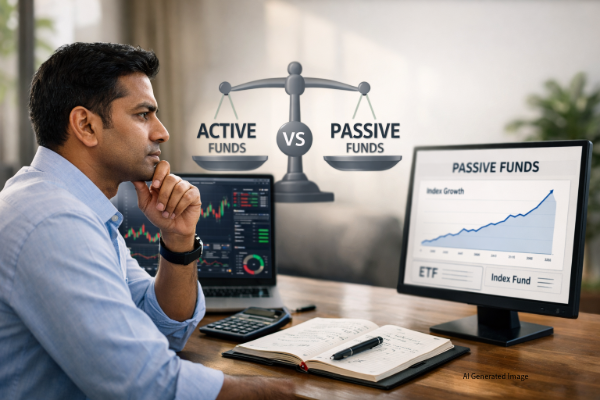
Investing your hard-earned money is serious business. And if you are looking at mutual funds, you’ve probably stumbled upon this big question: Should I go with active mutual funds or passive mutual funds?
It’s a debate that’s been heating up in the investment world lately. Some swear by professional fund managers who actively pick stocks. Others believe in simply tracking the market. Both camps have valid points, and honestly, both approaches can help you build wealth.
But here’s the thing. they work in completely different ways. And understanding these differences isn’t just academic. It can literally make or break your retirement savings, your child’s education fund, or whatever financial goal you are working toward.
So let’s cut through the jargon and get to what really matters. By the end of this article, you’ll know exactly which type of mutual fund aligns with your money goals, risk appetite, and investment style.
What Are Active Mutual Funds?
Think of active mutual funds as having a skilled pilot flying your plane. You’ve got professional fund managers at the helm, constantly making decisions about which stocks or bonds to buy, hold, or sell.
These fund managers aren’t just sitting around. They’re analyzing company balance sheets at midnight, tracking economic trends, studying sector movements, and trying to spot opportunities before everyone else does. Their ultimate mission? Beat the benchmark index whether that’s the Nifty 50, Sensex, or any other relevant market index.
Key Features of Active Funds
Let me break down what makes active funds tick:
They’re professionally managed by experienced investment teams who eat, sleep, and breathe the markets. These folks have years of training and access to research that regular investors can only dream about.
The whole point is to outperform the benchmark. If the Nifty 50 gives 12% returns, an active fund aims for 14% or 15%. That’s the value proposition—better-than-market returns.
You’ll see higher portfolio churn here. Fund managers frequently buy and sell stocks based on their analysis. They’re not married to any particular stock if they think something better is available.
But all this expertise and activity comes at a price. Active funds charge higher expense ratios compared to their passive counterparts. We’ll dive deeper into what this means for your pocket in a bit.
Example
Let’s say you are looking at an actively managed large-cap fund. Instead of buying all 100 stocks in the Nifty 100 index, the fund manager might handpick what they believe are the best 40 to 50 companies. They’ll overweight sectors they’re bullish on and underweight those they’re skeptical about. It’s all about making judgment calls based on research and conviction.
What Are Passive Mutual Funds?
Now, passive mutual funds take a completely different route. If active funds are like having a pilot, passive funds are like setting your car on cruise control on a straight highway.
These funds don’t try to beat the market. Instead, they aim to become the market—or at least a slice of it. They track a specific index and replicate its performance as closely as possible.
You’ve probably heard of Nifty 50 Index Funds, Sensex Index Funds, or ETFs (Exchange Traded Funds). These are all forms of passive investing. The fund simply buys all the stocks in an index in the exact same proportion.
Key Features of Passive Funds
Here’s what defines passive mutual funds:
There’s no active stock selection happening. No fund manager is losing sleep over which company to pick. The index decides everything, and the fund just follows.
Low expense ratios are the headline feature. Since there’s no expensive research team or frequent trading, costs stay minimal. This is a massive advantage that compounds over time.
The portfolio is completely transparent. You always know exactly what you own because it mirrors the index. No surprises, no hidden bets.
Lower turnover means fewer buying and selling transactions. Stocks only change when the index itself gets rebalanced, which happens rarely.
Example
Take a Nifty 50 index fund. It will invest in all 50 companies that make up the Nifty 50—companies like Reliance, TCS, HDFC Bank, and Infosys. And it’ll hold them in the exact same weightage as the index. If Reliance is 10% of the Nifty 50, it’ll be roughly 10% of your fund too.
Active vs Passive Mutual Funds: Key Differences
Let’s put them side by side so you can see how they stack up:
Goal: Active funds aim to beat the market, while passive funds are happy matching it. This philosophical difference drives everything else.
Fund Management: Active funds involve constant decision-making and research. Passive funds? They’re on autopilot, mechanically following the index.
Expense Ratio: Here’s where it gets interesting. Active funds typically charge 1% to 2% annually in India. Passive funds? Usually between 0.1% to 0.3%. That’s a significant difference.
Risk Level: Active funds carry what we call “manager risk” the risk that your fund manager makes poor calls. Passive funds only carry market risk, which you can’t avoid anyway if you are investing in equities.
Return Potential: Active funds have the potential to outperform the index significantly. Passive funds will never beat it—they’ll match it minus a small tracking error.
Transparency: Passive funds win here hands down. You know exactly what you own at all times. Active funds disclose holdings periodically but maintain some opacity.
Cost Matters: Expense Ratio Comparison
Let’s talk about something that doesn’t get enough attention-costs. The expense ratio might seem like a small detail, but it’s actually one of the biggest determinants of your final returns.
Think of it this way: expense ratio is like a silent wealth killer. Every year, a percentage of your investment goes toward fees. This might not sound like much, but over decades, it’s massive.
Active equity funds in India generally charge between 1% and 2% annually. Some aggressive funds go even higher. Passive index funds, on the other hand, typically charge just 0.1% to 0.3%. The difference? A whopping 1% to 1.5% every single year.
Example
Let’s do some quick math to see what this means in real terms.
Suppose you invest ₹10 lakh and it grows at 12% annually for 20 years. With a 1.5% expense ratio (typical for active funds), your net returns drop to 10.5%. With a 0.2% expense ratio (typical for passive funds), you’re getting 11.8%.
Over 20 years, that difference translates to lakhs of rupees. The lower-cost passive fund would leave you with significantly more wealth, even though the gross returns were identical.
This is why many financial advisors now advocate for passive investing, especially for long-term goals. Lower costs mean more money stays in your pocket and keeps compounding.
Performance Reality: Do Active Funds Beat the Market?
Here’s the uncomfortable truth that the mutual fund industry doesn’t always advertise loudly: most active funds fail to beat their benchmarks over long periods.
Sure, in any given year, you’ll find several active funds that outperform. Some fund managers have genuine skill and consistently deliver. But here’s the catch—identifying these winners in advance is incredibly difficult.
Multiple studies tracking active fund performance in India and globally have shown that:
- A significant majority of active funds underperform their benchmarks when you look at 10 to 15-year track records
- Past performance is not a reliable indicator of future success
- The funds that outperform today might be tomorrow’s laggards
Why does this happen? Several reasons. Market timing is hard. Stock picking is hard. Even talented managers have bad years. High costs eat into returns. And sometimes, fund managers get moved around or leave, disrupting performance.
This reality check is exactly why passive funds have exploded in popularity over the past decade. If most active funds can’t beat the market after fees, why pay higher fees? Why not just buy the market and call it a day?
When Active Mutual Funds Make Sense
Despite the statistics, active funds absolutely have a place in your portfolio. They’re not dead—far from it.
Active funds can work brilliantly if:
You genuinely believe that skilled fund managers can add value through their research and experience. And look, some definitely can. It’s just that consistently identifying them is tough.
You are investing in market segments where inefficiencies exist. Mid-cap and small-cap stocks, for instance, aren’t as efficiently priced as large-caps. A good fund manager might genuinely find hidden gems here that passive funds would miss.
You are willing to regularly review and monitor fund performance. Active investing requires active oversight from you too. You can’t just invest and forget.
You are comfortable with higher volatility and the possibility of underperformance in some years. Active funds take concentrated bets, which can lead to more dramatic swings.
Sector funds and thematic funds also fall under active management. If you have strong conviction about a particular sector—say, infrastructure or pharmaceuticals—an actively managed sector fund lets you make that bet.
The bottom line? Active funds work best when chosen carefully, monitored regularly, and held for the right reasons.
When Passive Mutual Funds Make Sense
For a growing number of investors, passive funds are becoming the core holding. And there are solid reasons why.
Passive funds might be your best bet if:
You want low-cost, simple investing without constantly worrying about fund manager changes or performance rankings. Set it and forget it actually works here.
You prefer predictable market-linked returns. You won’t beat the market, but you definitely won’t lag it either (barring minimal tracking error).
You are investing for long-term goals like retirement (20-30 years away) or your child’s college education (15 years away). Time is your friend, and keeping costs low maximizes compounding.
You don’t want the hassle of tracking fund manager performance, reading quarterly reports, or worrying whether your fund manager is about to quit and join a rival firm.
For these scenarios, passive funds are genuinely hard to beat. They deliver exactly what the market delivers, at minimal cost, with zero drama.
Can You Combine Active and Passive Funds?
Here’s where it gets interesting—you don’t have to choose just one. In fact, many smart investors don’t.
A core-satellite strategy has become increasingly popular, and it makes a lot of sense:
Build your core portfolio with passive index funds (roughly 60% to 70% of your equity allocation). This gives you broad market exposure at minimal cost.
Create a satellite portfolio with carefully selected active funds (30% to 40%). These are your bets on fund managers you believe can outperform, or sector funds, or mid-cap/small-cap funds where active management might add value.
This approach balances cost efficiency with the potential for additional returns. Your core gives you stability and predictability. Your satellite gives you the upside potential of active management.
Plus, it’s psychologically easier. If your active funds underperform, your passive core keeps you steady. If your active funds crush it, your overall returns get a nice boost.
Risk Considerations
Let’s talk about risk for a moment because it’s not just about returns.
Active funds carry fund manager risk. What if the star manager who’s been delivering great returns leaves? What if they make a series of bad calls? You are placing a bet on human judgment, which can be fallible.
Passive funds carry market risk. If the market tanks, your index fund tanks equally. There’s no fund manager trying to protect your downside by moving to cash or defensive stocks.
The smart move? Diversify across fund types and asset classes. Mix active and passive funds. Include both equity and debt. Maybe add a bit of gold. This diversification reduces your overall portfolio risk while still giving you growth potential.
How to Choose Between Active and Passive Funds
Ultimately, this decision comes down to understanding yourself and your goals. Ask yourself these questions:
What is my investment horizon? If you are investing for 20+ years, the low-cost advantage of passive funds becomes almost unbeatable. For shorter horizons, you might take more active bets.
How much risk can I tolerate? Are you the type who panics when your fund underperforms for two quarters? Passive might suit your temperament better.
Do I want simplicity or am I willing to actively monitor? Be honest here. Many investors start with grand plans to review their portfolio monthly and then never do it. If that sounds like you, keep it simple with passive funds.
Am I comfortable paying higher fees for potential outperformance? Some investors gladly pay more if there’s a chance of beating the market. Others believe in keeping every possible rupee invested.
Your honest answers to these questions will point you in the right direction.
Final Verdict
So, who wins the battle between active and passive mutual funds?
The truth is—there’s no universal winner. Both have their place in the investing ecosystem.
If you value low cost, consistency, and simplicity, passive funds are your friend. They’re perfect for long-term wealth building without the drama.
If you seek potential outperformance and don’t mind the work of monitoring and reviewing, active funds can definitely add value—especially in certain market segments.
But for most investors, the sweet spot is a combination of both. Let passive funds form your core, and use active funds selectively where you see real potential for alpha generation.
The most important thing? Stay invested. Keep your costs low. Don’t chase past performance. And make sure your investments actually align with your financial goals and life stage.
Whether you choose active, passive, or a mix of both, starting early and staying consistent will always beat trying to time the market or find the next hot fund.
Your wealth-building journey is a marathon, not a sprint. Choose the approach that lets you stay in the race for the long haul.