
Common Tax Planning Mistakes Salaried People Make
Table of Contents
Discover the biggest tax planning mistakes salaried people make and learn proven strategies to save thousands. Expert tips on HRA, 80C, home loans and more.
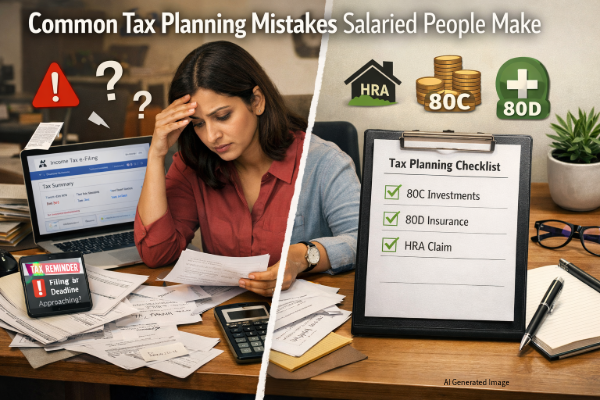
Let me be honest with you. Every March, I watch the same drama unfold. Colleagues rushing to buy insurance policies they don’t need. Friends panicking about tax-saving investments. WhatsApp groups buzzing with “best tax-saving options under 80C.”
Sound familiar?
Here’s the thing—tax planning isn’t a March marathon. It’s not about frantically googling “last minute tax saving options” when the financial year is almost over. For salaried professionals like you and me, effective tax planning is a year-round strategy that can literally transform your financial life.
And yet, year after year, I see smart, educated professionals losing lakhs of rupees simply because of avoidable tax planning mistakes. Money that could’ve been invested wisely. Money that could’ve grown into substantial wealth.
If you are drawing a monthly salary and want to keep more of your hard-earned money, this guide is exactly what you need.
Why Tax Planning Is Crucial for Salaried Individuals
Let’s face it we salaried folks don’t have the same flexibility as business owners when it comes to tax deductions. We can’t claim office expenses for our home WiFi or deduct travel costs as business expenditure. Our options are limited, which makes smart tax planning even more critical.
When you plan your taxes properly, you are not just saving money. You are actually building a foundation for long-term wealth. Think about it—every rupee saved on tax is a rupee that can be invested, compounded, and grown.
Good tax planning helps you reduce your legally payable tax burden, improve your actual take-home income, build valuable long-term assets, and completely avoid the last-minute panic and poor investment decisions that plague most people.
Now, let’s dive into the mistakes that are probably costing you money right now.
1. Waiting Until the Last Month to Plan Taxes
This is the granddaddy of all tax planning mistakes. I cannot tell you how many people I know who literally start thinking about taxes in late February or early March.
What happens then? Pure chaos.
You end up making hasty investments without proper research. You buy insurance policies that look good on paper but are completely unsuitable for your actual needs. You lock your hard-earned money into products with terrible returns just because they offer some tax benefit.
I’ve seen people invest in Unit Linked Insurance Plans (ULIPs) with exorbitant charges. I’ve watched colleagues commit to monthly premiums they can barely afford. All because they waited too long.
The Better Approach
Start your tax planning in April itself—right at the beginning of the financial year. I know it sounds boring when you are just recovering from filing last year’s returns, but trust me on this.
Set up Systematic Investment Plans (SIPs) in ELSS funds. Schedule monthly contributions to your PPF account. Spread your Section 80C investments across the entire year instead of dumping everything in March.
This approach does two wonderful things. First, it removes the financial pressure of finding ₹1.5 lakh suddenly in March. Second, it instills discipline in your financial life. You’d be surprised how much easier everything becomes when you are not rushing.
2. Choosing Tax-Saving Products Only for Deductions
Here’s a conversation I had last month with a friend:
“I bought this insurance policy. Paying ₹50,000 per year for 20 years.”
“Great! What’s the cover amount?”
“₹10 lakh.”
“Wait… and what are you getting at maturity?”
“Around ₹15 lakh after 20 years.”
I didn’t know whether to laugh or cry. This person was essentially parking ₹10 lakh for 20 years to get back ₹15 lakh. That’s barely 2% annual returns—worse than a savings account! All for a Section 80C deduction.
Why This Approach Destroys Wealth
When you invest purely to save tax, you ignore everything that actually matters. Does this product align with your financial goals? Are the returns decent? What about liquidity—can you access the money if you need it?
Most tax-saving insurance policies are terrible investment products. They combine insurance and investment poorly, charge high fees, and deliver pathetic returns.
The Correct Strategy
Flip your thinking. First, figure out what you actually need. Protection for your family? Buy term insurance—it’s cheap and provides huge coverage. Want to build wealth? Invest in equity mutual funds or ELSS.
Match your investments to your goals first. Then, cherry-pick the ones that also happen to offer tax benefits. Tax saving should be the bonus, not the main criteria.
3. Not Comparing Old Tax Regime vs New Tax Regime
Since the government introduced the new tax regime, this has become a massive source of confusion and lost money.
I meet people who blindly stick to the old regime because “that’s what I’ve always done.” I also meet people who switch to the new regime assuming it’s automatically better because the tax slabs look simpler.
Both groups are potentially leaving money on the table.
The Common Mistake
Assuming one regime is universally better. It’s not. The right choice is deeply personal and depends on your specific situation.
What You Should Actually Do
Every single year, sit down and calculate your tax liability under both regimes. Yes, every year, because your situation changes. you might buy a house, your salary might increase, you might start paying rent.
The old regime makes sense if you are claiming significant deductions—HRA, home loan interest, Section 80C investments, Section 80D for health insurance. The new regime works better if you have minimal deductions and prefer higher take-home without investment pressure.
I’ve seen this simple comparison save people anywhere from ₹15,000 to ₹75,000 annually. That’s not pocket change.
4. Ignoring House Rent Allowance (HRA) Planning
HRA is one of the most powerful tax-saving tools available to salaried individuals. And yet, I’m constantly amazed by how many people mess this up or ignore it completely.
Some people don’t bother submitting rent receipts to their employer. Others submit them incorrectly. Many forget to get a proper rent agreement drafted, which can create problems during scrutiny.
The Result?
You lose a completely legitimate exemption that could’ve saved you thousands.
Smart HRA Planning
This is not complicated. Maintain all your rent receipts properly. Digital copies work perfectly fine. Have a proper rent agreement in place, even if you are renting from family. If you are paying rent to parents, ensure you are doing bank transfers (not cash), and get a proper declaration from them acknowledging the income.
Here’s something many people don’t know-if your annual rent exceeds ₹1 lakh, you need to provide your landlord’s PAN. Make sure you have it.
Proper HRA planning can easily reduce your taxable income by ₹2-3 lakh or more, depending on your city and rent amount. That’s substantial savings right there.
5. Not Maximizing Section 80C Properly
Section 80C is the most popular tax-saving section. Everyone knows about it. And yet, people use it terribly.
The most common issue? Dumping all ₹1.5 lakh into one single instrument, usually whatever their insurance agent is pushing that year. This creates concentration risk and often locks you into poor-performing products.
The Balanced Approach
Think of Section 80C as a diversification opportunity, not just a tax-saving checkbox. Spread your ₹1.5 lakh across multiple instruments based on your needs.
Your EPF and VPF contributions are automatically covered—these are stable and safe. Add some PPF for long-term, guaranteed returns with complete safety. Invest in ELSS mutual funds for wealth creation with market-linked returns and the shortest lock-in period (just 3 years). And yes, include your life insurance premium, but only for term insurance, not investment-linked plans.
This mix gives you safety, growth, and flexibility while maximizing your tax deduction.
6. Overlooking Health Insurance Deductions (Section 80D)
This one frustrates me the most because it’s such low-hanging fruit. People buy health insurance—which is great—but then completely forget to claim the deduction under Section 80D.
What You Can Actually Claim
Up to ₹25,000 for premiums paid for yourself, your spouse, and your children. An additional ₹25,000 for premiums paid for your parents. And if your parents are senior citizens, that second limit jumps to ₹50,000.
That means a salaried individual with senior citizen parents can claim up to ₹1,00,000 in deductions just for health insurance (₹50,000 if both the individual and parents are senior citizens, or ₹25,000 + ₹50,000 if only parents are senior citizens). In the 30% tax bracket, that’s ₹30,000 saved annually.
And yet, I see so many people missing this completely.
7. Not Claiming Home Loan Benefits Correctly
Bought a house? Congratulations! You now have access to two major tax deductions that can save you serious money.
You can claim the principal repayment under Section 80C (up to ₹1.5 lakh) and the interest payment under Section 24(b) (up to ₹2 lakh for self-occupied property).
Common Mistakes People Make
They forget to collect the interest certificate from their bank. They don’t claim benefits jointly when they’re co-owners with a spouse (both can claim separately). They miss out on claiming pre-construction interest, which can be claimed over five years once construction is complete.
Proper planning of home loan benefits can reduce your annual tax by ₹50,000 or more. Get the documentation right, understand the co-ownership benefits, and don’t leave this money with the government.
8. Ignoring Tax on Other Income
Your salary is not your only income. Most people have interest from fixed deposits, interest from savings accounts, maybe some freelance income on the side, dividend income, or capital gains from selling investments.
All of this is taxable. And all of this is frequently forgotten when people estimate their tax liability.
The Consequence
You end up with a shortfall in advance tax, which can lead to interest charges and penalties. Or worse, you get a surprise tax demand that messes up your financial planning.
Simple Solution
Maintain a simple spreadsheet. Every quarter, update it with all your income sources. FD interest, freelance payments, capital gains from mutual fund redemptions everything. This takes 15 minutes but saves you from nasty surprises.
9. Depending Only on Employer's Tax Calculation
Your employer’s HR department is doing their job. Calculating tax based on the information and declarations you’ve submitted. But here’s what they’re not doing. suggesting better investment options, comparing old vs new regime for you, optimizing your overall deductions, or planning for your other income sources.
They’re working with limited information and standardized calculations.
What You Should Do
Take ownership. Review your tax computation independently at least twice a year once in April when you are planning, and once in January before the year ends. If tax planning isn’t your strength, spend ₹2,000-₹5,000 on a consultation with a qualified tax advisor. That fee often pays for itself many times over.
10. Not Using Tax Planning as a Wealth-Building Tool
This is the biggest mindset shift most people need to make. Tax planning is not just about paying less tax to the government. It’s about converting mandatory savings into wealth-building opportunities.
Think about it. You have to invest ₹1.5 lakh anyway to save tax. Why not invest it in ELSS funds that have the potential to give you 12-15% returns instead of traditional insurance products giving you 5-6%?
You need retirement savings. Why not use NPS, which not only gives you additional tax benefits under Section 80CCD(1B) but also builds a substantial retirement corpus?
This approach transforms tax planning from a compliance exercise into a wealth creation strategy.
Simple Annual Tax Planning Checklist
Before we wrap up, here’s a practical checklist you can use every year:
Compare your tax liability under both old and new tax regimes in April. Review how you’ll utilize the ₹1.5 lakh Section 80C limit across different instruments. Check and plan your Section 80D health insurance deductions for yourself and parents. Verify and organize all HRA documents—receipts, agreement, landlord PAN. Track all other income sources quarterly—FD interest, capital gains, freelance income. Review your overall investment allocation to ensure it matches your goals. Reassess your financial goals annually and adjust tax planning accordingly.
Final Thoughts
Look, I get it. Tax planning sounds boring. Spreadsheets, sections, calculations—none of this is as exciting as planning your next vacation or buying the latest smartphone.
But here’s the reality. good tax planning can easily add ₹50,000 to ₹1,50,000 to your annual savings without you earning an extra rupee. That’s a 10-20% increment without asking your boss for a raise.
And it’s not even about complex strategies or aggressive tax avoidance. It’s simply about being proactive instead of reactive, choosing the right products for the right reasons, and treating tax planning as wealth planning.
Start early. Plan properly. Invest wisely. Your future self will thank you.
If you are feeling overwhelmed or unsure about your specific situation, investing in a consultation with a qualified chartered accountant or tax advisor is one of the smartest financial decisions you can make. Their fee is almost always recovered several times over through better planning and avoided mistakes.
Remember, it’s not about how much you earn. It’s about how much you keep and grow. And smart tax planning is your biggest ally in this journey.