
Financial Planning Checklist for Salaried Employees in India
Table of Contents
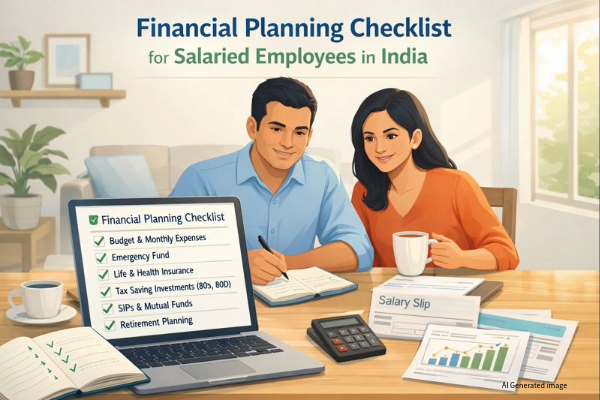
Let’s be honest getting that monthly salary feels great. There’s comfort in knowing exactly when the money hits your account. But here’s what most salaried professionals don’t realize. a steady paycheck doesn’t automatically translate to financial security.
I have seen countless high-earning professionals living paycheck to paycheck. Doctors making ₹2 lakhs a month with zero savings. IT managers earning well into six figures who panic when an emergency strikes. The problem isn’t the income it’s the absence of a solid financial plan.
Rising living costs eat into your purchasing power. Lifestyle inflation sneaks up after every increment. Job uncertainty is real, even in so called “stable” sectors. And medical emergencies. They don’t care about your bank balance before striking.
Whether you are fresh out of college in your 20s, building your career in your 30s, or approaching your peak earning years in your 40s, this comprehensive financial planning checklist for salaried employees in India will help you build wealth, protect your family, and sleep better at night.
Understand Your Salary Structure Clearly
This might sound basic, but you’d be surprised how many people don’t actually understand their salary slip. I am not talking about just knowing your CTC—I mean really understanding where every rupee goes.
Your salary structure directly impacts everything from tax liability to loan eligibility to actual take-home pay. Here’s what you absolutely must track:
Basic Salary: This is your foundation. A higher basic means better PF contributions and a stronger retirement corpus.
House Rent Allowance (HRA): If you are paying rent, this is your friend. HRA exemptions can save significant tax under the old regime.
Special Allowances: These are often taxable, but understanding them helps you plan better.
Provident Fund Contributions: Both your contribution and your employer’s contribution. This is forced retirement savings and it’s actually a good thing.
Professional Tax: A state-level deduction that varies based on where you work.
TDS (Tax Deducted at Source): Know how much tax is already being deducted so you can plan additional investments if needed.
Here’s the thing about salary structure two people with the same CTC can have vastly different take-home salaries based on how components are structured. Your loan eligibility for a home loan depends heavily on your basic salary. Your retirement corpus builds faster with higher PF contributions.
Action step: Pull out your salary slip right now. If something doesn’t make sense, ask your HR team. Review your Form 16 every April without fail. Financial planning for salaried employees starts with knowing what you actually earn.
Build an Emergency Fund
If I could enforce just one financial rule for every salaried employee in India, this would be it. An emergency fund isn’t optional it’s the foundation of financial security.
Think about what happened during the pandemic. Companies laying off employees. Salary cuts. Medical emergencies with hospital bills running into lakhs. The people who survived these shocks with dignity. They had emergency funds.
Your emergency fund protects you from life’s curveballs. sudden job loss, medical crises, urgent family obligations, unexpected relocations, major home or vehicle repairs.
How much is enough?
If you are single with no dependents: 6 months of expenses minimum.
If you have a family, EMIs, or aging parents. 9 to 12 months of expenses.
If you are in a high-risk job or business: Even higher.
Where should you park this money?
Keep it liquid and accessible. A savings account works for immediate access. Liquid mutual funds give slightly better returns with redemption in 24 hours. Sweep-in fixed deposits offer both liquidity and decent returns.
Here’s what NOT to do with your emergency fund. don’t invest it in equity mutual funds, don’t lock it in tax-saving FDs, don’t put it in that “hot stock tip” your colleague gave you. Emergency funds need to be boring and accessible. That’s the whole point.
Get Adequate Health Insurance
Most salaried employees make a dangerous assumption they think their company health insurance is enough. It’s not.
Your employer’s health insurance has a critical flaw. it disappears the day you change jobs or retire. And in today’s job market, who stays with one company for 30 years.
Besides, company health covers are often inadequate. A ₹3-5 lakh cover might sound decent until someone in your family needs surgery or prolonged hospitalization. Metro city hospitals can burn through that amount in a single serious illness.
What makes a good personal health insurance policy for salaried employees?
Individual or family floater coverage based on your family structure.
Sum insured of at least ₹10-15 lakhs for metro cities, ₹8-10 lakhs for tier-2 cities.
No co-payment clauses where you have to pay a percentage.
Reasonable room rent limits (or better yet, no limits).
Lifetime renewability so you are covered even after retirement.
Coverage for pre and post-hospitalization expenses.
Your employer’s health insurance should be your backup, not your primary defense. Get a personal health cover early premiums are much lower when you are young and healthy. Waiting until you have health issues makes insurance expensive or even impossible to get.
Buy Pure Term Life Insurance Early
Let me ask you a direct question. if something happens to you tomorrow, will your family be financially secure?
If anyone your spouse, kids, parents, or siblings depends on your income, term insurance isn’t negotiable. It’s the most affordable way to ensure your family doesn’t struggle financially if you are not around.
How much life cover do you actually need?
A good rule of thumb is 15 to 20 times your annual income. So if you earn ₹10 lakhs annually, you need at least ₹1.5 to ₹2 crore coverage.
Add your liabilities outstanding home loan, car loan, personal loans.
Factor in future goals children’s education, their marriage, parents’ healthcare.
Adjust for inflation because expenses will only increase over time.
Critical tips for buying term insurance:
Buy it young. A 25-year-old pays significantly less than a 35-year-old for the same coverage.
Choose pure term insurance. Avoid those fancy “insurance cum investment” plans like endowment or ULIPs. They are expensive and deliver mediocre returns.
Check the claim settlement ratio. You want an insurer who actually pays claims, not one who finds excuses to deny them.
For a salaried employee doing financial planning properly, term insurance is the cheapest way to buy peace of mind.
Plan Your Taxes Smartly
Tax planning has become more complex since the government introduced the new tax regime. Now you have to actively choose which regime benefits you more and the answer isn’t the same for everyone.
The old regime works better if you:
Claim HRA because you are renting a house.
Invest in traditional tax-saving instruments like PPF, ELSS, life insurance.
Have a home loan and can claim interest deduction.
Have significant deductions under 80C, 80D, and other sections.
The new regime makes sense if you:
Have minimal deductions and don’t want the hassle.
Have a high basic salary with fewer allowances.
Prefer simplicity over tax optimization.
Calculate your tax liability under both regimes every financial year. Your situation changes you might get married, take a home loan, or have different income levels. What worked last year might not be optimal this year.
Start Goal-Based Investing
I see this all the time people starting SIPs because their friends are doing it or because some influencer on social media said so. They invest ₹5,000 monthly in random mutual funds without knowing why.
That’s not financial planning for salaried employees that’s gambling with better marketing.
Every rupee you invest should have a purpose. Goal-based investing gives your money direction and your decisions clarity.
Common financial goals for salaried employees:
Short-term goals (1-3 years): International vacation, new gadget upgrade, emergency fund top-up, wedding expenses.
Medium-term goals (5-10 years): Car purchase, house down payment, child’s higher education, business startup fund.
Long-term goals (15+ years): Retirement corpus, children’s education and marriage, complete financial independence.
Simple asset allocation based on time horizon:
Equity mutual funds for long-term goals they handle inflation and compound beautifully over time.
Debt instruments for short-term goals protect your capital when you need money soon.
Hybrid or balanced funds for medium-term goals they give both growth and stability.
When you link investments to specific goals, you won’t panic during market crashes. You won’t withdraw prematurely. You won’t chase hot tips. You’ll invest with discipline because you know exactly what you’re building toward.
Retirement Planning: Start Earlier Than You Think
“I am only 28, retirement is decades away.” That’s exactly the kind of thinking that leads to a stressful retirement.
The brutal truth about retirement in India:
you’ll likely live longer than you think, medical expenses will be significantly higher, inflation will destroy your purchasing power, and there will be no monthly salary to fall back on.
Your EPF alone won’t cut it. Not even close.
Comprehensive retirement planning checklist:
Maximize your EPF contributions—it’s tax-free and gives decent returns.
Consider Voluntary Provident Fund (VPF) for additional savings beyond mandatory PF.
Invest in NPS for equity exposure and additional tax benefits.
Build a portfolio of equity mutual funds for long-term wealth creation.
Don’t ignore PPF—it’s safe, tax-free, and perfect for conservative investors.
How much do you need?
A simple calculation: if your current annual expenses are ₹6 lakhs, you’ll need a retirement corpus of ₹1.5 to ₹1.8 crores (25-30 times annual expenses) to maintain your lifestyle. And that’s assuming you retire today. Factor in 20-30 years of inflation, and the number grows significantly.
This is why financial planning for salaried employees must include aggressive retirement planning from day one of your career.
Control Lifestyle Inflation
You get a 20% increment. Fantastic! But here’s what usually happens: your EMI increases, you upgrade your car, you move to a bigger apartment, you start eating out more. Within months, you are back to feeling broke despite earning more.
This is lifestyle inflation, and it’s a wealth killer.
Warning signs you’re in the lifestyle inflation trap:
Your EMIs keep increasing with every salary hike.
You earn significantly more than you did five years ago but have the same (or less) savings.
You depend on credit cards for regular expenses.
You can’t remember the last time you invested more than you spent.
Smart financial habits to control lifestyle inflation:
Follow the 50-30-20 rule: 50% needs, 30% wants, 20% savings and investments.
Increase your SIP by at least 10% with every salary increment.
Set up automatic transfers to investment accounts on salary day save first, spend later.
Keep total EMIs below 35-40% of your monthly income.
Wealth isn’t built by earning more it’s built by saving and investing more. A person earning ₹50,000 who saves ₹15,000 is wealthier than someone earning ₹2 lakhs who saves nothing.
Review Loans and Credit Health
Not all loans are bad. A home loan builds an asset. An education loan can multiply your earning potential. But credit card debt, personal loans, and buy-now-pay-later schemes? They are financial quicksand.
Good debt builds assets:
Home loans (tax benefits plus asset creation).
Education loans (investment in your earning potential).
Risky debt drains your cash flow:
Credit card outstanding (18-36% interest rates are insane).
Personal loans (expensive and often used for consumption).
Buy-now-pay-later schemes (convenient but dangerous for impulsive spending).
Credit health checklist for salaried employees:
Maintain a credit score above 750—it gets you better loan rates.
Never pay just the minimum due on credit cards you’ll be trapped forever.
Prepay high-interest loans first (personal loans, car loans).
Check your credit report annually for errors or fraud.
Use credit cards for convenience and rewards, not as a monthly loan facility.
Review Your Financial Plan Every Year
Financial planning isn’t something you do once and forget. Your life changes, tax rules change, your goals evolve, and your financial plan must keep pace.
Review your complete financial plan annually if:
You have changed jobs or got a significant salary hike.
You have gotten married or had a child.
You have taken a major loan (home, car, personal).
Tax laws have been updated.
You have achieved a financial goal or added new ones.
Your risk profile has changed (becoming more or less conservative).
An annual financial review keeps you aligned with reality. You’ll catch mistakes early, rebalance your portfolio, adjust insurance coverage, and stay on track toward your goals.
Final Thoughts
Being a salaried employee in India gives you one massive advantage: predictability. You know when money is coming, roughly how much, and can plan accordingly.
But predictability without planning is just wasted potential.
If you follow this financial planning checklist for salaried employees in India, you’ll transform your financial life. You’ll reduce money-related stress and anxiety. You’ll build long-term wealth systematically. You’ll protect your family from financial disasters. You’ll retire with dignity and freedom.
The best time to start was yesterday. The second-best time is today.
Start simple with just one or two items from this checklist. Build your emergency fund. Get proper insurance. Start one goal-based SIP. Don’t try to do everything at once financial planning is a marathon, not a sprint.
Stay consistent. Review regularly. Adjust as needed. And remember, financial planning for salaried employees isn’t about perfection—it’s about progress.
Your future self will thank you for the steps you take today.