
Is Business Insurance Mandatory in India? Laws for MSMEs
Table of Contents
Wondering if business insurance mandatory in India? This 2026 guide explains which insurance covers are legally required for MSMEs under Indian law, with penalties for non-compliance explained simply.

Running a small business in India is already a challenge. Between managing cash flow, hiring the right people, dealing with GST filings, and staying ahead of competition, insurance often gets pushed to the bottom of the list.
But here is the question most MSME owners eventually ask: Is business insurance mandatory in India?
It is a fair question, and the honest answer is: it depends on your business. Some types of business insurance are compulsory under Indian law. Others are not legally required but carry serious financial risks if you skip them.
This guide breaks down exactly what applies to your MSME, which laws govern mandatory business insurance in India, and what happens if you ignore compliance.
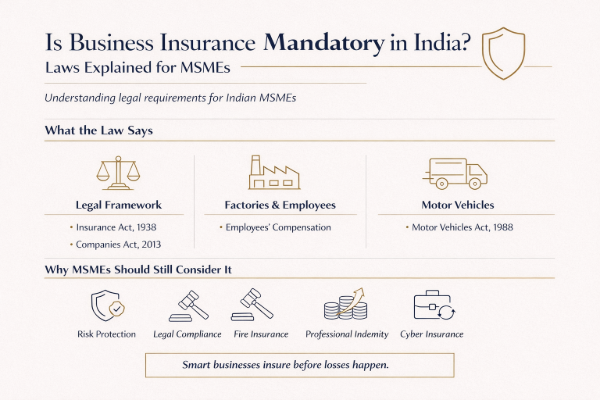
Is Business Insurance Compulsory in India?
There is no single blanket law in India that forces every business owner to buy a business insurance policy. The reality is more nuanced than that.
Whether business insurance is compulsory for your MSME depends on three main factors: how many employees you have, what kind of business you operate, and whether you own commercial vehicles.
Certain industry-specific laws make specific insurance covers legally binding. If your business falls under those categories, compliance is not optional. Ignoring it means inviting penalties, legal liability, and in some cases, criminal prosecution.
Let us look at each mandatory insurance type in detail.
Mandatory Business Insurance in India (With Laws Explained)
1. Employees’ State Insurance (ESI)
The Employees’ State Insurance Act, 1948 is one of the most important labour laws governing MSMEs in India. Under this Act, factories employing 10 or more workers across India, and shops or other establishments employing 10 or more workers in most states, where employees earn up to Rs. 21,000 per month, must register under the ESI scheme.
ESI contributions are shared between the employer and the employee. Employers currently contribute 3.25% of gross wages, while employees contribute 0.75%.
The ESI scheme covers the following:
- Medical treatment for employees and their dependents
- Cash benefits during sick leave
- Maternity benefits for women employees
- Disability compensation for workplace injuries
- Dependent family benefits in case of death
If your business qualifies and you have not registered, the ESIC (Employees’ State Insurance Corporation) can levy penalties, initiate prosecution, and recover all unpaid contributions with interest. For growing MSMEs, non-compliance with ESI is one of the most common and costly mistakes.
2. Employees’ Compensation Insurance
The Employees’ Compensation Act, 1923 places a direct legal obligation on employers to compensate workers who suffer injuries, disabilities, or death in the course of employment. This includes physical accidents at the workplace and occupational diseases linked to specific industries.
While the Act itself does not say you must buy an insurance policy, the financial exposure it creates is significant. A single serious injury claim can run into lakhs of rupees, which is why most MSMEs with factory workers, delivery staff, drivers, or fieldworkers take out a Workmen Compensation Insurance policy.
This type of business insurance is practically mandatory for any MSME in manufacturing, logistics, or construction. If a worker is injured and you cannot pay, the courts will not consider whether you bought insurance. The liability falls entirely on you as the employer.
3. Motor Insurance for Company Vehicles
This one is non-negotiable. The Motor Vehicles Act, 1988 makes third-party motor insurance compulsory for every vehicle on Indian roads, without exception. If your business owns cars, bikes, delivery vehicles, trucks, or any commercial transport, you must have at minimum a valid third-party motor insurance policy.
Third-party motor insurance protects you financially if your business vehicle causes injury, death, or property damage to a third party. Under the Motor Vehicles (Amendment) Act, 2019, penalties for driving without insurance include a fine of Rs. 2,000 and/or imprisonment of up to 3 months for a first offence, rising to Rs. 4,000 and/or imprisonment for repeat offences.
If your MSME runs a fleet, consider upgrading to a comprehensive motor insurance policy that also covers damage to your own vehicles.
4. Public Liability Insurance (For Hazardous Industries)
If your business deals with hazardous substances such as chemicals, inflammable materials, explosives, or toxic gases in quantities at or above the limits prescribed under the Environment Protection Act, 1986, you are required by law to carry Public Liability Insurance under the Public Liability Insurance Act, 1991.
This law was enacted to ensure that businesses operating in high-risk sectors can compensate the public in the event of accidents. It covers third-party injuries, deaths, and property damage caused by industrial mishaps.
Manufacturing MSMEs that use chemicals, operate pressure vessels, or store hazardous goods must verify compliance carefully. The Ministry of Environment, Forest and Climate Change along with state-level authorities actively monitors adherence to this Act.
What Is NOT Legally Mandatory (But Highly Recommended)
This is the section where many MSME owners develop a false sense of security. Just because a policy is not mandated by law does not mean you can afford to go without it.
Here are the key covers that are legally optional but financially essential for most small businesses in India:
- Fire and Property Insurance: A Standard Fire and Special Perils policy protects your business premises, stock, and equipment from losses due to fire, floods, storms, and related perils. For any business with physical assets, a fire incident without insurance can be the end of the road.
- Business Interruption Insurance: This covers loss of income if your business has to shut down temporarily due to a covered event. Very few MSMEs carry this cover, which is a costly oversight.
- Professional Indemnity Insurance: Critical for consultants, CA firms, architects, engineers, IT service providers, and medical professionals. If a client claims financial loss due to your professional advice or negligence, this policy covers legal defence and compensation.
- Cyber Insurance: In 2026, no business is completely safe from cyberattacks. Data breaches, ransomware, and phishing are increasingly common even among small businesses. Cyber insurance covers financial losses, legal costs, and notification expenses after a breach.
- Directors and Officers (D&O) Insurance: Relevant for private limited companies and startups, this protects founders and directors from personal liability arising from regulatory actions, shareholder disputes, or management decisions.
Insurance Requirements Based on Business Type
Understanding your MSME category helps you identify exactly what is required and what is advisable.
Retail Shop with Fewer Than 10 Employees
ESI is not applicable below the threshold. If you own a delivery vehicle, third-party motor insurance is mandatory. A shop insurance or fire policy is strongly recommended to protect your inventory and fittings.
Manufacturing Unit with 15 or More Employees
ESI registration is mandatory. Workmen Compensation Insurance is practically essential. Public Liability Insurance is required if hazardous substances are involved in your operations. Fire and property insurance is strongly advisable given the asset exposure.
IT Startup with 20 or More Employees
ESI is mandatory. Professional Indemnity Insurance is not legally required but is critical for client-facing work. Cyber Insurance has become a near-essential cover for any business handling customer data or operating cloud systems.
What Happens If You Ignore Mandatory Insurance?
Non-compliance with mandatory business insurance laws in India carries real consequences. These are not just theoretical warnings.
Under the ESI Act, failure to register can lead to prosecution under Section 85, with fines and imprisonment for the responsible officer. Unpaid ESI contributions attract interest at 12% per annum, in addition to separate penalty provisions.
Driving a business vehicle without third-party motor insurance can result in a fine of Rs. 2,000 and/or imprisonment for a first offence, with higher penalties for repeat offences under the amended Motor Vehicles Act.
Non-compliance with the Public Liability Insurance Act can attract regulatory action and civil liability for any damages caused to affected parties.
Beyond legal penalties, the bigger risk is financial. One serious employee injury claim, one road accident, or one fire can wipe out years of savings if you are not adequately covered.
Is GST Registration Linked to Insurance?
No. GST registration in India does not require you to purchase any business insurance policy.
However, if your MSME takes a business loan, finances machinery, or leases commercial property, your lender or lessor may require specific insurance as part of the agreement. In such cases, insurance becomes a contractual obligation rather than a statutory one. It is still an obligation you cannot ignore.
Why MSMEs Should Not Think "Mandatory Only"
Too many small business owners in India take the approach of doing only the bare minimum. If the law does not require it, they do not buy it.
This mindset is financially dangerous. Consider these scenarios: a rented shopfront catches fire and destroys your entire inventory. An employee slips and sustains a permanent disability. A client sues your firm for delivering incorrect advice. A cyberattack compromises your customer database.
In every one of these situations, the right insurance policy can mean the difference between recovery and total business closure. Business insurance in India is not just a compliance box to tick. It is genuine financial protection for everything you have built.
How to Check If Insurance Is Mandatory for Your MSME
Follow this five-step process to determine your compliance status:
- Check your total employee headcount and whether their salaries fall within the ESI threshold.
- Review whether your operations involve hazardous substances, which triggers Public Liability Insurance requirements.
- Confirm whether your business owns any vehicles, which makes motor insurance compulsory without exception.
- Speak with a qualified insurance advisor who understands MSME-specific requirements in your industry and state.
- Review any loan, lease, or client contracts that may impose additional insurance obligations beyond statutory requirements.
Your compliance profile depends on business operations and workforce size, not turnover alone.
Final Verdict: Is Business Insurance Mandatory in India?
Yes and no, depending on your business structure and operations.
For Indian MSMEs, employee-related insurance under the ESI Act is strictly enforced for eligible businesses. Motor insurance is compulsory for every commercial vehicle on the road. Public Liability Insurance is required for hazardous industries. Workmen Compensation coverage is practically unavoidable for businesses with field or factory workers.
Other covers like fire insurance, professional indemnity, and cyber insurance are not legally required, but the financial risk of skipping them can be devastating, especially for small businesses with limited reserves.
Smart MSME owners do not just ask what the law requires. They ask what risks their business faces. Answer both questions honestly, and you will arrive at the right insurance strategy for your business in 2026.
FAQs
Is business insurance compulsory for small shops in India?
Is fire insurance mandatory for MSMEs?
Do startups need business insurance?
Can a sole proprietor operate without insurance?
Disclaimer
The information provided in this article is for general informational and educational purposes only. While every effort has been made to ensure accuracy based on current Indian laws and regulations, including the Employees’ State Insurance Act, 1948, Employees’ Compensation Act, 1923, Motor Vehicles Act, 1988, and Public Liability Insurance Act, 1991, laws may change over time and may vary based on state-specific rules and business structure.
This content does not constitute legal, tax, or insurance advice. Readers are advised to consult a qualified legal professional, chartered accountant, or licensed insurance advisor before making any compliance or insurance-related decisions for their business.
The author and publisher shall not be held responsible for any loss or liability arising directly or indirectly from the use of the information contained in this article.