
Tax Planning vs Tax Saving: Key Differences Explained
Table of Contents
Discover the crucial differences between tax planning vs tax saving. Learn how strategic tax planning can save you lakhs over your lifetime while building real wealth.
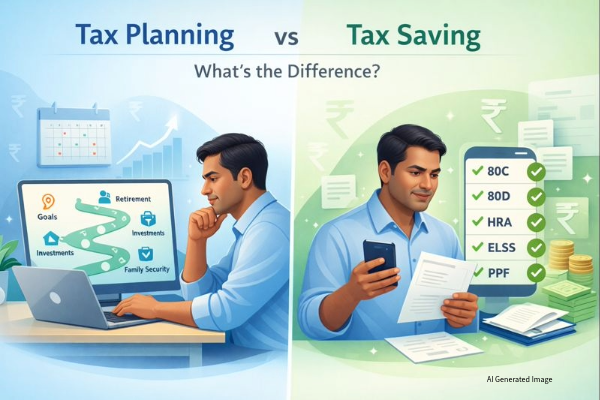
Let me paint you a familiar picture. It’s February, and you suddenly remember you haven’t done anything about your taxes. Panic sets in. You frantically call your insurance agent, scramble to find investment options, and somehow manage to put together ₹1.5 lakh under Section 80C before March 31st rolls around.
Sound familiar? You are not alone. Millions of Indians go through this annual ritual, believing they’re being smart about their taxes. But here’s the truth what you are doing is tax saving, not tax planning. And that distinction. It can literally make or break your financial future.
Today, I want to walk you through the real difference between tax planning and tax saving. Trust me, once you understand this, you’ll never look at your taxes the same way again.
What Is Tax Saving?
Think of tax saving as a fire drill. The alarm goes off (tax season arrives), and you grab whatever’s closest to you and run. It’s reactive, rushed, and honestly, a bit chaotic.
Tax saving means using specific provisions under the Income Tax Act to reduce how much tax you owe right now. You are essentially looking for deductions, exemptions, and rebates that can bring down your taxable income for the current financial year.
Common Examples of Tax Saving Instruments
Here’s where most of us put our money when tax season hits:
Section 80C investments let you claim deductions up to ₹1.5 lakh annually. This includes ELSS mutual funds, PPF, EPF contributions, life insurance premiums, and NSC. It’s the most popular tax-saving avenue in India, and honestly, it’s the first thing that comes to mind when someone says “save tax.”
Then there’s Section 80D covering health insurance premiums. You can claim up to ₹25,000 for yourself and your family, and another ₹50,000 if you are paying for your parents’ health insurance (especially if they’re senior citizens).
Got a home loan? Section 24(b) allows you to deduct up to ₹2 lakh on the interest portion of your EMI. Add Section 80CCD(1B), which gives an additional ₹50,000 deduction for NPS contributions beyond the 80C limit.
Don’t forget the standard deduction of ₹50,000 for salaried employees and the HRA exemption if you are paying rent.
Characteristics of Tax Saving
Here’s what defines tax saving:
It’s all about this year. You are focused on reducing your tax bill for the financial year that’s about to end. Next year? That’s a problem for future you.
The deadline drives everything. Most tax saving happens between January and March. It’s not planned it’s pressured.
It’s product-focused rather than goal focused. Your insurance agent tells you about a policy that saves tax, so you buy it. Your friend invested in something, so you follow suit. There’s rarely any thought about whether it actually fits your financial goals.
And here’s the kicker tax saving might actually work against your long-term interests. You might end up locking money in low-return products, buying insurance you don’t need, or investing in schemes that don’t match your risk profile.
Tax saving is important, absolutely. But doing only tax saving without planning? That’s like trying to build a house by just buying bricks without any blueprint.
What Is Tax Planning?
Now, tax planning is a different beast altogether. It’s strategic, intentional, and most importantly, it’s year-round.
Tax planning means organizing your entire financial life your income, investments, expenses, and assets in a way that legally minimizes your tax liability while helping you achieve your financial goals. Notice I said “life,” not just “current year.”
Examples of Tax Planning
Real tax planning looks like this:
Every year, you sit down and evaluate whether the old tax regime or the new tax regime makes more sense for your situation. You run the numbers. You consider your deductions. You make an informed choice.
You structure your salary components intelligently. Maybe you take a portion as telephone allowance, conveyance allowance, or LTA when it makes sense. You are not just accepting the default salary structure.
You build a diversified portfolio that includes taxable investments (like bank FDs), tax-deferred investments (like NPS), and tax-free options (like equity mutual funds held long-term). Each serves a purpose in your overall strategy.
You time your capital gains and losses strategically. Maybe you book losses to offset gains in a particular year. Maybe you stagger your equity redemptions to stay within favorable tax brackets.
When retirement comes, you plan your withdrawals carefully. You might withdraw from different sources in different years to minimize the tax impact. You might use your senior citizen benefits optimally.
Tax planning answers a fundamental question: “How do I structure my finances to legally pay the least possible tax over my entire lifetime?” Not just this year your lifetime.
Key Differences Between Tax Planning and Tax Saving
Let me break down the differences in a way that really hits home:
Time horizon: Tax saving is short-sighted. You are looking at the next three months. Tax planning takes the long view years, even decades.
Approach: Tax saving is reactive. You are responding to the approaching deadline. Tax planning is proactive. You’ are making decisions throughout the year based on your overall strategy.
Focus: Tax saving tries to reduce this year’s tax bill. Tax planning works to minimize your tax burden across years, sometimes even accepting a higher tax in one year if it means lower taxes overall.
Strategy: Tax saving is product-based. “Buy this policy, invest in this scheme.” Tax planning is goal-based. “I want to retire at 50 with ₹5 crore. How do I get there tax-efficiently?”
Impact: Tax saving gives you limited, immediate benefits. Tax planning creates compounding benefits that grow exponentially over time.
Here’s a concrete example: Tax saving is buying ELSS funds in March because you need to hit your 80C limit. Tax planning is building a complete equity-debt-retirement portfolio that considers your age, risk appetite, goals, liquidity needs, and yes, tax efficiency all while you are investing throughout the year.
Why Tax Planning Matters More Than Tax Saving
I’ve seen this play out hundreds of times in my career. People who focus only on tax saving often end up:
Over-investing in low-return products. Yes, that insurance policy gives you a tax deduction, but it’s barely beating inflation. You could have done better.
Buying unnecessary insurance. You don’t need three term insurance policies just because they save tax. One adequate policy is enough.
Locking money in unsuitable schemes. That five-year tax-saving FD seemed like a good idea until you needed the money for your child’s education in year three.
Creating poor diversification. All your money is in PPF and insurance? Where’s the growth going to come from?
Tax planning, on the other hand, ensures you get:
Better post-tax returns. This is huge. A 12% return with favorable tax treatment often beats a 15% return with high taxation.
Flexibility and liquidity. Your money isn’t all locked up. You have access when life happens.
Goal alignment. Every investment serves a purpose buying a home, funding education, building retirement corpus.
Lower lifetime tax burden. This is where the real magic happens. Over 30 years, proper tax planning can save you lakhs, even crores.
Let me put it simply: tax saving reduces today’s tax bill. Tax planning improves your entire financial future.
Tax Planning in the Old vs New Tax Regime
Right now, India offers two tax regimes, and choosing between them is itself a crucial planning decision.
The old regime allows all those deductions and exemptions we talked about. It’s great if you have a home loan, you are investing regularly, and you have substantial deductions to claim.
The new regime offers lower tax rates but strips away most deductions. It’s simpler, requires less paperwork, and might be better if you don’t have many deductions anyway.
A real tax planner doesn’t just pick the easier option. They evaluate:
- Your income level across all sources
- Your investment capacity and patterns
- Your existing and planned deductions
- Your long-term financial goals
- Your family situation
Then they choose the regime that results in the lowest total tax not just the lowest effort or the most popular choice among friends.
I’ve seen cases where someone earning ₹15 lakh benefits more from the new regime, while someone earning ₹20 lakh saves more with the old regime. It’s highly individual, and it can change from year to year based on your circumstances.
How Tax Planning Supports Wealth Creation
Here’s what most people miss: smart tax planning isn’t about avoiding tax. It’s about using the tax laws efficiently to build wealth faster.
Consider equity mutual funds for long-term goals. Hold them for over a year, and you pay just 12.5% on gains above ₹1.25 lakh. That’s incredibly tax-efficient compared to other options.
PPF and EPF give you tax-free maturity. The entire corpus comes to you without any tax deduction. That’s powerful when you are looking at ₹50 lakh or ₹1 crore accumulated over decades.
NPS offers a triple tax benefit deduction on contribution, tax-free growth, and partial tax-free withdrawal. Where else do you get that?
Health insurance protects you financially while giving you a tax deduction. It serves both purposes beautifully.
Each planning decision serves dual purposes: financial security and tax efficiency. That’s not tax avoidance that’s smart money management.
Common Mistakes People Make
Through my years as a tax planner, I’ve seen these mistakes repeatedly:
Waiting until March is the biggest one. By then, your options are limited, and you are making rushed decisions.
Buying products only for deduction without considering returns, liquidity, or goal alignment. The tax benefit becomes irrelevant if the product doesn’t serve your needs.
Ignoring asset allocation. Just because something saves tax doesn’t mean you should put all your money there.
Not reviewing old investments. That policy you bought ten years ago for tax saving might not make sense anymore. Review and rebalance regularly.
Assuming one-size-fits-all. What works for your colleague or friend might be completely wrong for you.
These mistakes turn tax saving into an expensive habit. You think you are being smart, but you are actually leaving money on the table.
How to Start Smart Tax Planning
Ready to shift from tax saving to tax planning? Here’s your roadmap:
Start by listing your financial goals. When do you want to buy a house? When will your kids need education funding? When do you want to retire? Get specific.
Understand your risk tolerance. Are you comfortable with market volatility, or do you prefer stable returns? This affects your investment choices significantly.
Review all your income sources. Salary, rental income, capital gains, interest income everything. Each has different tax implications.
Choose suitable investment buckets that match your goals, timeline, and risk profile. Then optimize for tax within those choices.
Optimize deductions without letting them drive your decisions. The deduction is the bonus, not the reason.
Review annually. Your life changes, tax laws change, your goals change. Your tax plan should evolve accordingly.
Working with a qualified tax advisor or financial planner can help you avoid costly errors and identify opportunities you might miss on your own.
Tax Planning + Tax Saving = Complete Strategy
Here’s how I want you to think about it:
Tax saving is a tool—like a hammer or a screwdriver. Tax planning is the blueprint for building your dream home.
You need both. The best tools in the world are useless without a plan. But a brilliant plan goes nowhere without the right tools to execute it.
Both are necessary, but planning always comes first. Let your plan guide your saving decisions, not the other way around.
Final Thoughts
If you only focus on saving tax, you might save a few thousand rupees this year. Maybe you’ll high-five yourself on April 1st for beating the deadline.
But if you focus on tax planning, you can potentially save lakhs even crores over your lifetime. More importantly, you’ll build real, lasting wealth that supports the life you actually want to live.
The smartest investors I know don’t ask “Which section can I use to save tax?” when March approaches.
They ask “What is the most tax-efficient way to reach my goals?” throughout the year.
That shift in thinking from reactive to strategic, from short-term to long-term, from product-focused to goal-focused makes all the difference.
So which camp are you in? Are you just saving tax, or are you actually planning? The answer to that question might be worth more than any deduction you’ll claim this year.
Start planning today. Your future self will thank you.
FAQs
What is the main difference between tax planning and tax saving?
Is tax saving a part of tax planning?
Yes. Tax saving is a subset of tax planning. While tax saving deals with specific deductions, tax planning looks at the bigger picture asset allocation, goal-based investing, and lifetime tax efficiency.
Does the new Income-tax Act, 2025 change the concept of tax planning?
Are popular tax-saving options like PPF, ELSS, and NPS still relevant under the new law?
Yes. These instruments continue to be recognized for tax benefits, though the section numbers and structure may change. Their core advantages long-term savings, compounding, and tax efficiency remain intact.