
Term Insurance vs ULIP vs Endowment - Which One Is Best?
Table of Contents
If you have been shopping for life insurance lately, you have probably felt overwhelmed. Walk into any bank or meet an insurance agent, and they’ll throw a dozen policy names at you. Term plans, ULIPs, endowment plans, money-back policies the list goes on.
Here’s the truth most agents won’t tell you. mixing insurance with investment rarely gives you the best of either. You end up with mediocre protection and disappointing returns.
I have spent years helping people untangle their insurance mess, and I can tell you this: understanding the difference between term insurance, ULIP, and endowment plans is the first step toward making smart financial decisions.
Let’s break down these three products without the jargon, compare them honestly, and figure out which one makes sense for your situation.
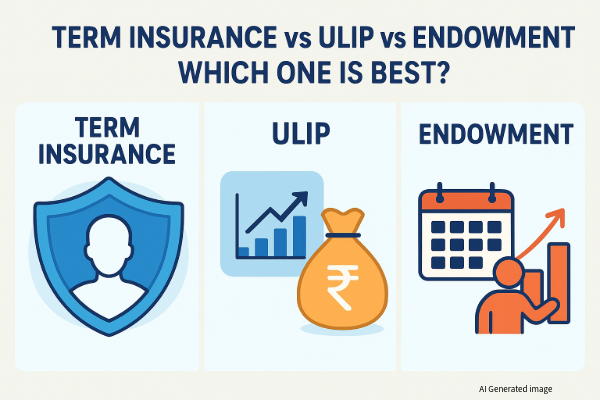
Understanding Term Insurance: The Pure Protection Play
Term insurance is the simplest life insurance product you can buy. There’s no investment component, no maturity benefit, no complicated fund structures. Just straightforward financial protection for your family.
Here’s how term insurance works: you pay a small annual premium, and if something happens to you during the policy term, your nominee receives a large sum assured. If you outlive the policy term, you don’t get any money back. That’s it.
Sounds too simple. That’s because it is. And that simplicity is exactly what makes term insurance so powerful.
Think about it this way. a 30 year old non smoker can get a ₹1 crore life cover for around ₹10,000-12,000 per year. That’s roughly ₹1,000 per month for ₹1 crore of protection. Show me any other financial product that offers this kind of leverage.
Who should buy term insurance?
If you have people who depend on your income a spouse, children, aging parents, or anyone who would struggle financially if you weren’t around term insurance isn’t optional. It’s essential.
Young professionals in their 20s and 30s should make term insurance their absolute first insurance purchase. The premiums are dirt cheap at this age, and you lock in those low rates for decades.
Even if you’re single with no dependents right now, buying term insurance early makes sense. Once you get married or have kids, you’ll be glad you already have coverage in place at rates that would be much higher if you waited.
Tax benefits with term insurance
Your term insurance premiums qualify for deduction under Section 80C (up to ₹1.5 lakh). The death benefit your family receives is completely tax free under Section 10(10D). These tax benefits make term insurance even more attractive from a pure protection standpoint.
What Exactly Are ULIPs? Insurance Meets Investment
ULIP stands for Unit Linked Insurance Plan. Think of it as a hybrid product that tries to give you life insurance and investment returns in a single package.
When you pay your ULIP premium, the insurance company splits it into two buckets. One portion goes toward providing life cover . The remaining amount gets invested in market linked funds that you choose equity funds, debt funds, or balanced funds.
The investment portion works somewhat like mutual funds. Your money buys “units” of the chosen fund, and the value of these units goes up or down based on market performance.
The ULIP charges you need to know about
ULIPs come with several charges that eat into your returns. premium allocation charges, policy administration charges, fund management charges, and mortality charges. While IRDAI has capped these costs in recent years, ULIPs still remain more expensive than standalone mutual funds.
For the first few years, a significant chunk of your premium goes toward these charges rather than investment. This is why financial advisors always tell you that ULIPs only make sense if you stay invested for at least 10-15 years.
ULIP features that might interest you
ULIPs have a mandatory 5 year lock in period. You cannot withdraw your money before completing five years. After the lock in, you can make partial withdrawals for specific needs.
You also get flexibility to switch between equity and debt funds based on market conditions, which can be useful for managing risk as you approach your financial goals.
Important tax update for ULIPs
Here’s something crucial. if your annual ULIP premium exceeds ₹2.5 lakh (for policies bought after February 2021), the maturity proceeds become taxable. This was a major policy change that affects high-premium ULIP buyers.
Who should consider ULIPs?
ULIPs make sense for people who want a disciplined, long term investment vehicle with built in insurance. If you are the type who might panic and redeem investments during market downturns, the 5 year lock in can actually work in your favor by forcing you to stay invested.
They are suitable for long term goals like retirement planning or children’s education (10-15 years away). If you are comfortable with market volatility and understand that equity investments need time to deliver returns, ULIPs can be part of your portfolio.
Endowment Plans: The Guaranteed Maturity Route
Endowment plans take a completely different approach. They combine life insurance with a savings component that promises to return money at maturity, regardless of market performance.
You pay fixed premiums throughout the policy term. If something happens to you during this period, your nominee gets the sum assured. If you survive the policy term, you receive a maturity amount that includes your premiums plus bonuses (in participating plans) or a guaranteed amount (in non-participating plans).
Understanding endowment plan returns
The returns from endowment plans are significantly lower than market linked investments. Expect somewhere between 4-6% annually, which barely keeps pace with inflation. Some participating endowment plans have historically delivered around 6-7%, but there are no guarantees on the bonus amounts.
The trade off here is certainty. You know you’ll get your money back and then some at maturity. There’s no market risk, no volatility, no sleepless nights watching stock prices.
The liquidity problem
Endowment plans lock your money for the entire policy term, typically 10-20 years. If you need to withdraw early, you will face surrender charges that can wipe out a significant portion of your accumulated value. The liquidity is extremely poor compared to other investment options.
Who benefits from endowment plans?
Endowment plans work for ultra conservative investors who prioritize capital safety over growth. If market volatility gives you anxiety and you’d rather earn modest, predictable returns, endowment plans offer that peace of mind.
They’re also popular with parents planning for specific future expenses like a child’s education or marriage, where the goal is to ensure a certain amount will definitely be available on a target date.
The Head-to-Head Comparison You Actually Need
Let’s cut through the marketing speak and compare these products on what really matters:
Premium cost differences
Term insurance wins by a landslide. For the same ₹1 crore coverage, your term insurance premium might be ₹12,000 annually. A ULIP offering ₹1 crore cover could cost ₹80,000-1,00,000 per year. An endowment plan with ₹1 crore maturity benefit? Easily ₹1,50,000-2,00,000 per year.
The premium differences are massive because term insurance provides only protection, while ULIPs and endowment plans try to build corpus alongside insurance.
Returns and growth potential
Term insurance offers zero returns (and that’s perfectly fine it’s not meant to). ULIPs can deliver 10-12% returns over long periods if invested primarily in equity, though this comes with volatility. Endowment plans typically deliver 4-6% returns with much more stability.
If wealth creation is your goal, ULIPs beat endowment plans over the long term. If stability matters more than growth, endowment plans win that round.
Risk levels
Term insurance carries no investment risk. Your only “risk” is outliving the policy term and not receiving any money back but that’s actually a good outcome because it means you are alive.
ULIPs carry moderate to high risk depending on your fund allocation. Heavy equity exposure means higher potential returns but also steeper short term losses during market downturns.
Endowment plans carry minimal risk. Your capital is safe, and you are guaranteed to receive at least your maturity amount (though the returns might disappoint).
Tax treatment across all three
All three products offer tax benefits under Section 80C for premium payments (up to ₹1.5 lakh limit). The proceeds are tax-free under Section 10(10D) with certain conditions.
For ULIPs bought after February 2021, remember that the ₹2.5 lakh annual premium cap determines whether maturity proceeds remain tax exempt.
What Should You Actually Do? Practical Recommendations
After comparing hundreds of insurance purchases, here’s what typically works best for most people:
Step 1: Buy term insurance first
Get a term plan with adequate coverage typically 15-20 times your annual income. This ensures your family’s financial security even if the worst happens. The premiums are so affordable that there’s simply no excuse to skip this.
Buy it young, buy it early, and buy it adequate. A 30 year old buying term insurance locks in cheap premiums for the next 30-40 years. Wait until you are 45, and you’ll pay 3-4 times more for the same coverage.
Step 2: Keep insurance and investment separate
For most people, buying separate term insurance for protection and investing in mutual funds for wealth creation works better than mixing the two through ULIPs or endowment plans.
Mutual funds offer lower charges, better transparency, easier liquidity, and superior fund options compared to ULIPs. You can stop and restart SIPs based on your cash flow, which you can’t easily do with ULIPs.
Step 3: Consider ULIPs only in specific situations
ULIPs make sense if you need forced discipline and won’t otherwise invest regularly. The lock in period and structured premium payments can actually help people who might otherwise spend the money.
If you want tax efficient investing combined with insurance in a single product, and you are committed to staying invested for 15 plus years, ULIPs can work well. Just make sure you understand all the charges involved.
Step 4: Buy endowment plans sparingly
Endowment plans should be a small part of your portfolio, if at all. They work for people who are extremely risk averse and can’t stomach any market volatility.
If you are young (under 40) and have a long investment horizon, endowment plans will likely underperform inflation and leave you with inadequate wealth at retirement. Your 30 year old self doesn’t need guaranteed returns you need growth.
Making Your Final Decision
There’s no universal “best” choice among term insurance, ULIP, and endowment plans. The right answer depends entirely on your specific situation:
Consider your current age and life stage. Young professionals need maximum life cover at minimum cost term insurance wins. Mid-career professionals building wealth might add ULIPs for long-term goals. Those nearing retirement and wanting capital preservation might allocate some funds to endowment plans.
Think about your risk tolerance honestly. Can you handle seeing your investment value drop 20% in a market crash, knowing it’s temporary. Go for ULIPs. Does market volatility keep you awake at night. Endowment plans or conservative ULIP debt funds might suit you better.
Evaluate your financial discipline. If you are great at maintaining investment discipline on your own, skip ULIPs and go the term insurance + mutual fund route. If you need forced saving, ULIPs provide that structure.
Conclusion
Here’s what I tell everyone who asks about term insurance vs ULIP vs endowment:
Term insurance is essential for everyone with financial dependents. Buy it first, buy it adequately, and don’t overthink it.
ULIPs work well for long term investors who want combined insurance and investment, understand market risks, and can stay invested through ups and downs. They are not evil, just more suitable for specific situations.
Endowment plans serve ultra conservative investors who value certainty over growth. They are expensive for the protection offered, but they do provide guaranteed maturity that some people genuinely need for peace of mind.
For most young Indians, the winning combination is. term insurance for protection plus mutual funds for wealth creation. Keep it simple, keep costs low, and keep insurance separate from investment.
Whatever you choose, make sure you are buying insurance to protect your family, not because an agent convinced you it’s a great investment. Protection first, returns second always
FAQs
Which is better: Term Insurance, ULIP, or Endowment?
There is no single “best” option for everyone.
Term Insurance is best for pure protection, ULIPs work well for long term investors who want market linked growth, and Endowment plans suit people who prefer guaranteed savings. The right choice depends on your needs, risk appetite, and financial goals.
What is the main difference between these three insurance types?
Term Insurance provides only life cover.
ULIPs combine life cover with market linked investments.
Endowment plans offer savings plus life cover with stable but low returns.
Are Endowment plans guaranteed?
Non participating endowment plans offer guaranteed maturity amounts.
Participating plans include bonuses, which are not guaranteed and depend on the insurer’s performance.
Is ULIP better than Term Insurance?
No, they serve different purposes.
Term Insurance is essential for financial protection, while ULIPs are designed for investment plus insurance. Most people should buy Term Insurance first and then invest separately.