
What Happens Financially When You Lose Your Job Suddenly
Know what happens financially when you lose your job suddenly. Learn how to protect your savings, manage expenses, and avoid financial crisis during unemployment.
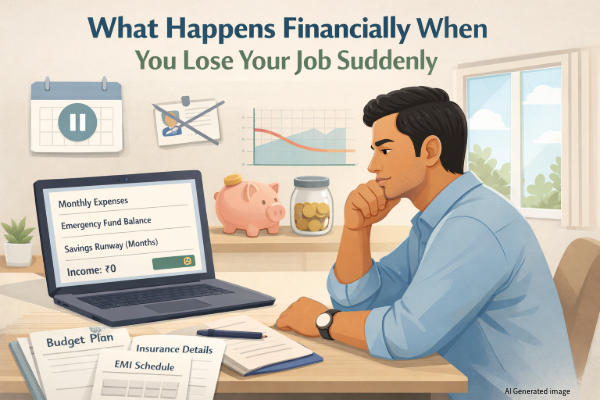
There’s nothing quite like the gut-wrenching moment when you realize your steady paycheck is gone. I have seen it happen to brilliant professionals, hardworking executives, and dedicated employees—sudden job loss doesn’t discriminate. One moment you are planning your next vacation, the next you are wondering how you’ll pay next month’s rent.
The harsh truth? When your job disappears overnight, your bills don’t follow suit. Your landlord still expects rent. The bank still wants its EMI. Your kids’ school fees don’t take a pause. This financial reality hits harder than most people expect, and frankly, it reveals everything about how prepared or unprepared you really are.
Whether you are facing layoffs due to company restructuring, economic downturns, health issues, or organizational changes, understanding the financial aftermath of sudden job loss can mean the difference between weathering the storm and drowning in it. Let me walk you through exactly what happens to your money when unemployment strikes without warning.
1. Your Monthly Cash Flow Takes an Immediate Hit
Let’s start with the obvious punch to the gut: your regular income vanishes instantly.
Think about how most of us structure our financial lives. Money flows in predictably every month salary credited on the same date, bonuses at expected times. Then money flows out just as predictably. EMIs get deducted automatically, rent goes out, school fees are paid, groceries are bought, utility bills are settled. It’s a rhythm we get comfortable with.
When sudden job loss happens, that entire rhythm collapses on one side. The outflow continues exactly as before, but the inflow? Gone.
What happens next depends entirely on your financial cushion. Your savings account suddenly shifts from “accumulation mode” to “survival mode.” Money that was meant for future goals now covers today’s groceries. Credit cards that you barely used might suddenly become lifelines. Some people start using overdraft facilities they swore they’d never touch.
Here’s what catches people off guard. even if you were earning well—say, ₹80,000 or ₹1,20,000 per month the financial strain becomes real within 30 to 60 days if you don’t adjust your spending immediately. High income without high savings offers zero protection against sudden job loss.
I have watched professionals who earned six-figure salaries panic within six weeks because their lifestyle expenses matched their income perfectly. They had nice cars, premium apartments, international vacations booked but almost nothing saved for emergencies.
The wake-up call? If you can’t list your exact monthly expenses right now down to the last subscription and coffee run job loss will expose that gap brutally and immediately.
2. Emergency Fund Becomes Your Lifeline
This is the moment your emergency fund earns its name. Not when the stock market dips. Not when a “can’t-miss” investment opportunity appears. Right here, right now, when you have lost your job suddenly and need money to survive.
A proper emergency fund does three critical things during unemployment:
First, it covers your essential expenses rent or EMI, food, utilities, insurance premiums, loan payments. These aren’t negotiable expenses; they are survival expenses.
Second, it buys you time. Time to find the right job, not just any job. Time to negotiate better offers instead of accepting the first desperate option out of fear. Time to retrain or upskill if needed. This time is invaluable, and it’s only possible if you have money set aside.
Third, it protects your mental health. Financial stress during job loss is overwhelming, but it’s ten times worse when you are watching your bank balance hit zero. An emergency fund provides breathing room, which translates directly into better decision-making.
So how much emergency fund do you really need?
- 3 months of expenses: Gives you a short breathing space, barely enough to start your job search properly
- 6 months of expenses: Provides better stability and reasonable time to find suitable employment
- 12 months of expenses: Creates a strong financial cushion that genuinely protects against prolonged unemployment
Without an emergency fund, I have seen people make desperate moves: breaking fixed deposits meant for their child’s education, withdrawing from their Provident Fund and paying penalties, taking personal loans at 14-18% interest rates, or worse borrowing from friends and family and straining relationships.
Every single one of these options weakens your long-term financial health. The irony? People skip building emergency funds because they want to invest aggressively for the future, but when sudden job loss strikes, they destroy those very investments to survive the present.
3. Fixed Expenses Start Feeling Heavier
There’s a category of expenses that simply doesn’t care about your employment status. These fixed commitments keep demanding money regardless of whether you are earning or not:
- Home loan EMIs
- Personal loan installments
- Rent payments
- Insurance premiums
- Children’s school or college fees
- Society maintenance charges
These aren’t expenses you can easily cut or negotiate away. Try explaining to your landlord that you’ll pay “whenever you feel like it.” Try telling the bank that your home loan EMI can wait because you are between jobs. It doesn’t work that way.
This inflexibility creates enormous pressure during sudden job loss. The bigger your fixed expenses relative to your previous income, the harder and faster you’ll hit the financial wall.
This reality forces people into uncomfortable situations:
- Requesting EMI rescheduling from banks (which isn’t always approved)
- Applying for loan moratoriums (which often just delays problems and adds interest)
- Making delayed payments that damage credit scores
- Negotiating with landlords for payment extensions
- Withdrawing children from expensive schools mid-year
Here’s the brutal math: if your fixed expenses consume 70-80% of your previous income, and you have minimal emergency savings, you’re looking at serious financial trouble within 60 days of sudden job loss.
4. Investments May Be Touched—Sometimes at the Wrong Time
Job loss has a nasty habit of forcing your hand on investments that were meant for completely different purposes.
That mutual fund SIP you started for retirement? You might redeem it for groceries.
Those stocks you bought for your daughter’s wedding in 10 years? Sold to pay this month’s rent.
The fixed deposits meant for your child’s education? Broken to cover EMIs.
Your EPF or PPF that was building for long-term security? Withdrawn prematurely with penalties.
The problem isn’t just that you are using these investments—it’s when you are forced to use them. Markets don’t care about your employment status. If you lose your job during a market downturn and need to redeem equity investments, you lock in losses. There’s no waiting for recovery when you need money for survival.
Beyond the timing issue, you lose something even more valuable. future compounding benefits. Money pulled out today isn’t just today’s amount—it’s years of future growth you’ll never see.
Then there are tax implications. Premature PF withdrawals? Taxable. Selling equity mutual funds? Capital gains tax. Breaking tax-saving fixed deposits early? You lose the deduction benefits.
Sudden job loss doesn’t just delay your long-term goals like retirement planning, buying a home, or funding children’s education it sometimes derails them completely. Not because the goals were unrealistic, but because liquidity wasn’t planned properly.
5. Insurance Coverage Becomes More Critical Than Ever
Here’s something that doesn’t get enough attention. job loss often means insurance loss.
Many people depend entirely on employer-provided health insurance. It’s convenient, it’s free, and it works great until you are no longer employed. Most corporate health policies terminate within 30-90 days of your exit from the company.
Now imagine losing your job and then facing a medical emergency in your family two months later. No income, no health insurance, and a hospital bill that could cost ₹3-5 lakhs or more. This scenario isn’t hypothetical; I’ve seen it destroy families financially.
Beyond health insurance, there’s the question of term insurance. If you don’t have adequate term life insurance independent of your employer, your family’s financial security is genuinely at risk. Job loss could become permanent due to disability, serious illness, or worse. Without proper term cover, your dependents face potential financial catastrophe.
This phase of unemployment becomes a harsh reminder: insurance isn’t just another expense to optimize or skip. It’s fundamental protection against financial collapse during uncertainty.
6. Mental Stress Often Leads to Financial Mistakes
Let’s talk about something financial advisors don’t emphasize enough. the psychological impact of sudden job loss on money decisions.
Losing your job isn’t just financially stressful it attacks your identity, confidence, and sense of security. That emotional chaos directly affects how you handle money during unemployment.
Stress and panic lead to terrible financial choices:
- Withdrawing investments in panic, even when it’s not immediately necessary
- Taking high-interest personal loans because you’re terrified of running out of money
- Selling assets unnecessarily at bad prices because you need “quick cash”
- Accepting job offers that are clearly wrong because desperation clouds judgment
I have watched intelligent professionals make decisions during unemployment that they’d never make otherwise purely because fear overrides logic.
The emotional toll also manifests in other ways: relationship stress over money, loss of sleep, health issues from anxiety, and sometimes even depression. All of these affect your ability to job hunt effectively, interview well, and present yourself confidently.
Here’s the hard truth: financial decisions made under emotional pressure almost always cause long-term damage. Staying calm and structured during sudden job loss is just as important as having money saved maybe more so.
7. Lifestyle Adjustments Become Necessary
When income stops, lifestyle must adjust. There’s simply no way around it.
The changes start small and become more significant:
- Restaurant meals get replaced by home cooking
- Streaming subscriptions get cancelled
- Gym memberships are paused
- Weekend getaways stop
- Shopping trips end
- Premium coffee becomes regular coffee
- Cabs become public transport
For some people, these adjustments feel like deprivation. For others, they are eye-opening revelations about how much money was being wasted.
Here’s what I have noticed. people who adjust their lifestyle quickly and proactively during sudden job loss tend to recover faster financially. They stretch their emergency fund further, reduce financial stress, and regain a sense of control.
Those who resist adjustment who keep spending as if nothing changed—burn through savings at frightening speed and often face genuine crisis.
The lifestyle reset isn’t permanent, but it’s necessary. And honestly? Many people discover they don’t miss most of those expenses once they are gone.
8. Your Financial Priorities Change Permanently
There’s something transformative about experiencing sudden job loss firsthand. It changes how you think about money forever.
People who’ve been through unemployment typically emerge with different financial priorities:
- They build larger emergency funds often 12 months instead of 3-6
- They avoid unnecessary debt like it’s toxic
- They resist lifestyle inflation even when income increases
- They focus obsessively on cash flow planning
- They maintain personal insurance regardless of employer benefits
- They diversify income sources when possible
In many cases, sudden job loss becomes a painful but powerful financial wake-up call. It teaches lessons that no financial advisor, book, or seminar ever could.
How to Protect Yourself From Financial Shock
You can’t always prevent job loss, but you absolutely can reduce its financial impact:
Build a robust emergency fund: Target 6-12 months of essential expenses, kept in liquid form
Control fixed expenses: Keep them at 50% or less of your income
Avoid excessive debt: Just because you qualify for a loan doesn’t mean you should take it
Get personal insurance: Health and term insurance that isn’t dependent on employment
Review finances regularly: Monthly cash flow reviews prevent nasty surprises
Upskill continuously: Your skills are your real job security
Financial preparedness doesn’t eliminate the stress of sudden job loss, but it fundamentally changes the experience from crisis to manageable challenge.
Final Thoughts
Losing your job suddenly isn’t merely a career setback it’s a complete financial stress test of everything you have built.
Those with proper planning experience discomfort and adjustment.
Those without planning face genuine crisis and potentially devastating consequences.
The purpose of financial planning isn’t to predict when job loss will happen—that’s impossible. The purpose is to ensure that when life inevitably throws surprises your way, your finances don’t completely fall apart.
If you are employed today and reading this, consider it a gift. You have time right now to prepare for uncertainty. Build that emergency fund. Get proper insurance. Control your expenses. Review your cash flow.
The best time to prepare for sudden job loss is now, while you still have income—not after you have received that unexpected termination letter.
Because when job loss strikes suddenly, it’s already too late to start planning.
FAQs
What should I do first after losing my job suddenly?
How much emergency fund is enough if I lose my job?
Should I break my investments to manage expenses?
Will losing my job affect my credit score?
Can I stop or pause my loan EMIs after job loss?
Disclaimer
The information provided in this article is for general educational and informational purposes only. It is not intended to be financial, investment, tax, or legal advice.
Financial situations vary from person to person, and the impact of job loss may differ based on income, expenses, liabilities, and personal circumstances. Readers are advised to evaluate their own financial situation carefully and consult a qualified financial advisor, tax professional, or other relevant expert before making any financial decisions.