
How to Build a Personal Money System That Actually Works on Autopilot
Table of Contents
Learn how to build a personal money system that automates saving, investing, bills, and spending. Reduce money stress and build wealth effortlessly month after month.
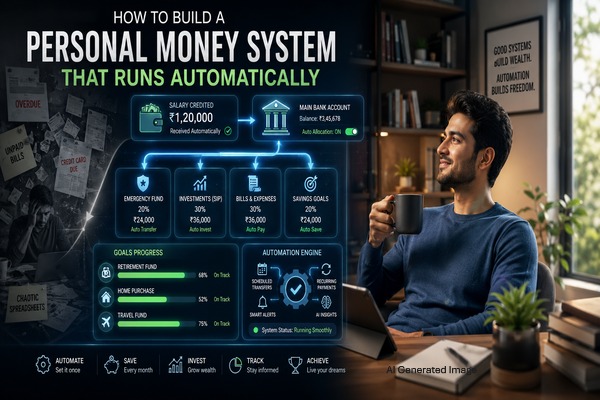
Picture this. Your salary hits your account. Before you even open your banking app, your SIPs are funded, your bills are paid, your emergency savings have grown, and you still have money sitting comfortably for the rest of the month.
No guilt. No confusion. No wondering where your money vanished.
That is exactly what a personal money system does for you.
Most people believe they struggle with money because they do not earn enough. But that is rarely the full picture. India has millions of salaried professionals earning decent incomes who still live paycheck to paycheck. The problem is almost never income. It is the absence of a system.
A personal money system removes the guesswork. It replaces willpower with automation. And it turns saving and investing from a monthly struggle into something that simply happens without you having to think about it.
Here is how to build one from scratch.
Why Your Brain Is Working Against You
Before we talk structure, let us talk psychology.
Humans are emotional decision-makers. We delay investing when markets look scary. We overspend when we feel stressed. We postpone savings when something more urgent appears. This is not a character flaw. This is just how the human brain is wired.
Behavioral finance research consistently shows that emotions drive a large portion of financial decisions. Fear, excitement, and social comparison all push us toward choices that hurt long-term wealth.
The solution is not to become a more disciplined person. The solution is to build a system where the right financial decisions happen automatically, before your emotions even get involved.
When saving is automatic, you cannot forget to save. When your SIP is set up, you cannot talk yourself out of investing during a market dip. The system does the heavy lifting.
Step 1: Give Every Rupee a Job
The foundation of any personal money system is knowing where your income is going before it arrives.
Think of your salary as water flowing into a tank. Without pipes directing the flow, the water just spills. A personal money system creates those pipes.
Here is a simple way to divide your monthly income:
Essential Expenses (50 to 60 percent): Rent or home loan EMI, groceries, utilities, insurance premiums, transport, school fees, internet. These are non-negotiable. They come first.
Investments (20 to 25 percent): This is your future money. Mutual fund SIPs, index funds, NPS contributions, EPF top-ups, or direct equity. The key principle here is to invest first and spend later, not the other way around.
Emergency Fund (10 percent until fully funded): A liquid reserve covering 3 to 6 months of expenses for salaried individuals, and 9 to 12 months for self-employed or those with variable income. Keep this in a separate savings account or a liquid mutual fund, not mixed with your daily spending account.
Lifestyle and Fun (10 to 15 percent): Travel, eating out, entertainment, shopping. This is guilt-free spending money. You have earned it. Spend it without anxiety because your savings and investments are already done.
These percentages are a starting point, not a rulebook. Your cost of living in Mumbai or Bengaluru is very different from someone living in a Tier 2 city. Adjust accordingly.
Step 2: Automate Savings Before You Spend Them
Most people follow this pattern: income arrives, expenses happen, and whatever is left over gets saved. The problem is that leftover money has a way of disappearing.
Flip the sequence. Automate your savings and investments on salary day itself, before discretionary spending begins.
Set up a standing instruction with your bank to transfer a fixed amount to your investment account or directly to your mutual fund folio on the 1st or 2nd of every month. Set a recurring deposit or auto-debit for your emergency fund. Let SIPs run without any manual intervention.
Now you are not saving what is left. You are spending what remains after saving. That single change in sequence has a far larger impact on long-term wealth than picking the perfect stock or timing the market perfectly.
Step 3: Keep Bills in a Separate Account
One underrated trick in any personal money system is opening a dedicated account for fixed expenses.
Most people use one bank account for everything rent, groceries, shopping, subscriptions, and travel. This creates a mental fog. You never quite know how much is truly available to spend.
Instead, maintain a separate account for fixed monthly outflows. On salary day, transfer the exact amount needed to cover your rent or EMI, insurance premiums, utility bills, school fees, and subscriptions. Set auto-debits to pull from this account.
Now your essential expenses are covered without any thought. You never miss a payment. And your primary spending account shows only the money that is actually yours to use freely.
Step 4: Automate Your Investments and Stop Timing the Market
Many retail investors in India fall into the same trap. They pause their SIPs when markets fall. They wait for the “right time” to start investing. They move money in and out based on news headlines.
This behavior consistently hurts returns.
Systematic Investment Plans work best when left undisturbed through market cycles. The mechanism of rupee cost averaging means you automatically buy more units when markets are low and fewer when markets are high. Over time, this smooths out the volatility in your average purchase price.
The data on this is clear. Long-term market data consistently shows that investors who stayed in their SIPs through volatile periods generated stronger outcomes than those who paused or tried to time their entries. A Business Standard analysis of 28 years of BSE Sensex SIP data found that starting at a market peak versus a market bottom made only a marginal difference in final returns. What mattered was simply staying invested.
Set your SIPs. Increase the SIP amount with every salary hike. And then leave them alone.
Step 5: Add a Few Simple Rules to Keep the System Running
Automation does most of the work, but a handful of personal rules help keep your money system healthy.
The 48-Hour Rule: Before any unplanned purchase above a certain amount, wait 48 hours. Most impulse purchases feel far less necessary two days later.
Step Up With Every Raise: Each time your salary increases, increase your SIP by at least half of that increment. If your take-home rises by Rs. 5,000, increase your investment contribution by Rs. 2,500. This prevents lifestyle inflation from swallowing every increment you earn.
Separate Short-Term and Long-Term Money. Money you need within 1 to 3 years should not be sitting in equity mutual funds. Vacations, car down payments, and home renovations have different time horizons than retirement. Match the investment vehicle to the goal.
Review Once a Month, Not Every Day. Your personal money system should run quietly in the background. Schedule a 30-minute monthly review. Check spending patterns, track goal progress, and confirm your automation is working. That is all. Checking your portfolio daily adds stress without adding value.
A Real-World Example
Say your monthly in-hand salary is Rs. 1,00,000. A personal money system might look like this:
Category Amount
Essential Expenses Rs. 50,000
Mutual Fund SIPs Rs. 20,000
NPS / Retirement Rs. 5,000
Emergency Fund Rs. 10,000
Lifestyle and Fun Rs. 10,000
Learning and Skills Rs. 5,000
On salary day, every automated transfer fires. By the time you check your account, your financial future is already being taken care of. The Rs. 10,000 in the lifestyle bucket is yours to enjoy without any guilt.
Mistakes That Quietly Kill a Personal Money System
Making it too complicated. A system with 15 categories and 8 accounts will collapse within two months. Start simple. Two or three accounts, a few automated transfers, and basic rules are more than enough.
Setting it and forgetting it forever. Automation is not a one-time setup. Life changes. Income grows. Goals shift. Family size changes. Review your personal money system once a year and adjust the allocations accordingly.
Neglecting cash flow in favor of returns. No investment strategy compensates for poor cash flow habits. Before optimizing your portfolio, tighten spending, reduce unnecessary debt, and build savings rate discipline.
Ignoring insurance: No personal money system is complete without adequate term life insurance and health insurance in place. These are not investments. They are the foundation that prevents a single event from wiping out years of savings.
The Real Point of All This
A personal money system is not about restriction or sacrifice. It is about removing the daily friction and mental overhead that comes with managing money manually.
When your finances are automated, you stop worrying about whether you saved this month. You stop feeling guilty about spending on a dinner out. You stop postponing that vacation because you are not sure you can afford it.
The money decisions have already been made. By the system. On your behalf.
That peace of mind is not just a nice bonus. For most people, it is the main reason to build a personal money system in the first place.
Start simple. Automate one thing this week. Then another next month. Over time, your personal money system will quietly build the financial life you actually want, month after month, year after year, without requiring your constant attention to do it.
FAQs
What is a personal money system?
A personal money system is a structured approach to managing your finances through predefined rules and automation. It determines how you save, invest, pay bills, and spend money with minimal manual effort.
How can I automate my finances?
You can automate finances by setting up automatic bank transfers, SIPs, bill payments, and recurring savings contributions that occur shortly after your salary is credited.
Is automatic investing a good idea?
Automatic investing can help build discipline and reduce emotional decision-making. It encourages consistent investing over long periods, which many investors find beneficial.
How much should I save every month?
The amount depends on your income, expenses, and goals. Many people aim to save and invest at least 20% of their income, but the right percentage varies from person to person.
What are the benefits of a money management system?
A money management system can reduce financial stress, improve savings habits, automate investing, simplify bill payments, and help you stay focused on long-term goals.