
The 5-Bucket Strategy for Managing Income Efficiently
Table of Contents
Learn the 5-bucket strategy for managing income efficiently, control spending, save consistently, and build long-term wealth without complicated budgeting.
Here is something most financial advisors will not tell you upfront.
Your income is probably not the problem.
The problem is that all your money lands in one account, sits there without any purpose, and quietly disappears over the next 30 days. You pay your bills. You spend a bit on things you enjoy. You maybe invest whatever is left, if anything is left at all. And then the cycle repeats.
This is not a discipline problem. This is a system problem.
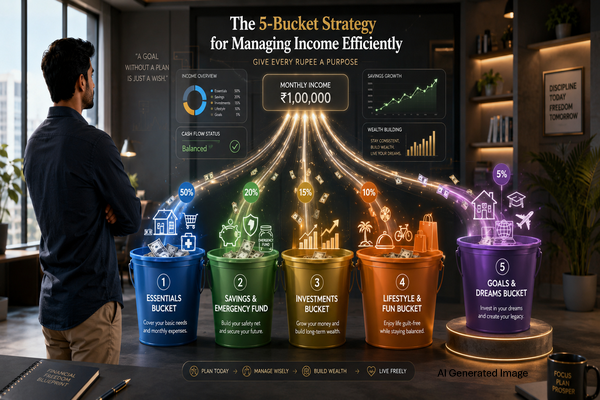
The 5-Bucket Strategy for managing income efficiently solves exactly this. It is a straightforward money management framework that gives every rupee a job the moment your salary arrives. No complicated spreadsheets. No guilt after spending. Just a system that runs on its own once you set it up.
Let us break it down.
What Is the 5-Bucket Strategy?
The 5-Bucket Strategy divides your income into five clearly defined categories, or “buckets,” each with a specific financial purpose. The idea is simple instead of treating your salary as one large pool of money, you split it upfront into portions that cover your needs, your enjoyment, your safety net, your future, and your goals.
Once the money is in a bucket, it stays there for that purpose. That boundary is what makes this system work.
The five buckets are:
- Essential Expenses
- Lifestyle and Fun
- Emergency Fund
- Investments and Wealth Creation
- Goals and Dreams
Bucket 1: Essential Expenses (50% to 60%)
This is the bucket that keeps your life running. Rent or home loan EMI, groceries, school fees, utilities, insurance premiums, transport costs, and phone bills all go here.
The general benchmark is to keep essential expenses below 60% of your take-home income. If this bucket is consuming 70% or 80% of what you earn, there is very little room left for anything else, including investments and savings.
The way to bring this number down is not dramatic. Review your recurring expenses with fresh eyes. Are you paying for subscriptions you barely use? Can you refinance a high-interest loan? Can you reduce convenience spending that has become habit rather than necessity?
Small reductions here compound into large financial breathing room over time.
Bucket 2: Lifestyle and Fun (10% to 20%)
This bucket exists because a financial plan that has no room for enjoyment is a plan most people abandon within three months.
This is your allocation for dining out, weekend trips, streaming subscriptions, shopping, hobbies, and anything that brings you genuine pleasure. The key is that you spend from this bucket without guilt, because the money is already allocated and accounted for.
When people try to cut lifestyle spending completely, they tend to hold on for a while and then overcorrect with a spending spree that undoes weeks of discipline. The 5-Bucket Strategy for managing income avoids this cycle entirely.
Enjoying your money responsibly is not a compromise. It is part of a sustainable financial life.
Bucket 3: Emergency Fund (10%)
Most financial disruptions are not catastrophes. They are expenses that arrive without warning and without invitation.
A job loss. A sudden medical expense. A vehicle repair that cannot wait. A family emergency that requires immediate travel.
Without a dedicated emergency fund, these situations push people toward personal loans or credit card debt, both of which are expensive ways to handle temporary cash shortfalls.
The recommended target for this bucket is:
- 3 months of expenses for salaried individuals with stable income
- 6 months of expenses for those in variable income roles or small business
- 9 to 12 months for self-employed professionals or freelancers
This money should sit in a liquid instrument such as a savings account or a liquid mutual fund, not in equities or locked-in deposits. The goal is not growth. The goal is availability.
Bucket 4: Investments and Wealth Creation (15% to 25%)
This is where long-term financial freedom is built.
The most important rule here is not about which instruments you choose. It is about timing. This bucket receives money first, right when your salary arrives, before discretionary spending happens.
Most people invest what is left after spending. The 5-Bucket Strategy for managing income efficiently flips that equation invest first, then spend the rest.
Within this bucket, equity mutual funds, index funds, SIPs (Systematic Investment Plans), NPS (National Pension System), PPF (Public Provident Fund), and ELSS funds are all suitable depending on your risk appetite, age, and goals.
Here is something worth internalizing about SIPs specifically: the power is not in the amount, it is in the regularity. A monthly SIP of Rs 5,000 maintained consistently for 15 to 20 years can build significant wealth through the combined effect of compounding and rupee cost averaging. More importantly, it removes the need to time the market, which even experienced investors consistently get wrong. Starting early and staying consistent matters far more than waiting for the perfect entry point or chasing the highest-rated fund.
Bucket 5: Goals and Dreams (5% to 15%)
Not every financial goal belongs in your long-term retirement bucket. Some goals are a few years away.
Buying a car. Taking a family vacation to Europe. Funding higher education. Saving for a home down payment. Planning your child’s wedding. Starting a side business.
These are real goals that deserve dedicated savings, and this bucket is where that happens. Instead of borrowing for every major life milestone or dipping into your investment bucket, you build toward each goal systematically.
This bucket also has a psychological benefit that is easy to underestimate. When you can see your vacation fund growing month by month, or your business fund accumulating steadily, it adds motivation to the overall system. Your money feels like it is working toward something meaningful.
If your monthly income is ₹1,00,000, you can divide it into five simple buckets. Allocate 55% (₹55,000) for essential expenses like rent, groceries, bills, and transportation. Set aside 15% (₹15,000) for lifestyle and fun so you can enjoy dining out, hobbies, or vacations without guilt. Keep 10% (₹10,000) in an emergency fund to prepare for unexpected situations. Invest 15% (₹15,000) towards wealth creation through options like mutual funds, stocks, or retirement savings. Finally, dedicate 5% (₹5,000) to your goals and dreams, such as higher education, starting a business, or planning a special trip. This simple allocation helps you balance today’s needs while securing your future.
These percentages are starting points, not fixed rules. Someone in their late 20s with no dependents might push investments to 30% and reduce lifestyle spending. Someone supporting aging parents might need 65% in essentials. The framework stays constant. The numbers flex around your life.
How to Automate This System
The most effective version of the 5-Bucket Strategy for managing income efficiently is one that runs automatically, with minimal decision-making required from you each month.
Open separate savings accounts for each major purpose. On the day your salary arrives, set up automatic transfers to your investment accounts, emergency fund, and goals account. What remains in your primary account is your spending money for the month, covering both essentials and lifestyle.
You stop making daily money decisions. You stop wondering whether you can afford something. The system has already decided for you.
Review the allocations once every three to four months. Income changes, goals evolve, expenses shift. Your buckets should reflect where you are, not where you were two years ago.
Why Most Budgets Fail and This System Does Not
Traditional budgets work by restriction. They tell you what not to do. Track every rupee. Cut every non-essential. Deny yourself the things you enjoy.
This approach fails because human willpower is finite. Eventually, the restriction becomes too uncomfortable and people abandon the budget entirely, often spending more than they would have otherwise as a reaction.
The 5-Bucket Strategy works differently. It starts with permission. You are allowed to spend on lifestyle. You are allowed to enjoy your income. The system just makes sure that enjoyment happens within a boundary that also protects your future.
That is the difference between budgeting from fear and budgeting from clarity.
Final Thoughts
Managing income efficiently in 2026 does not require complex tools, premium finance apps, or expert-level knowledge of markets. It requires a system that is simple enough to actually follow.
The 5-Bucket Strategy for managing income efficiently gives you structure without rigidity. It lets you spend without guilt, invest without confusion, save without stress, and work toward goals without borrowing.
You do not need to earn more to feel financially secure.
You need to give what you already earn a clearer direction.
Set up your five buckets this month. Automate the transfers. Then let the system do the heavy lifting while you get on with your life.
FAQs
What is the 5-Bucket Strategy for money management?
It is a system that divides income into five categories: essential expenses, lifestyle spending, emergency savings, investments, and goals. Each bucket has a specific purpose.
Is the 5-Bucket Strategy better than budgeting?
Many people find it easier because it focuses on allocating money with intention rather than tracking every expense.
How much should I allocate to investments?
A common recommendation is 15%–25% of income, but the ideal amount depends on your age, goals, and financial responsibilities.
Can salaried employees use this strategy?
Yes. In fact, salaried individuals can automate bucket allocations through salary accounts and recurring transfers.
Does this strategy work for irregular income?
Disclaimer
This article is for educational and informational purposes only and should not be considered financial, investment, tax, or legal advice. Please consult a qualified financial advisor before making any financial decisions.