
Hidden Cost of Convenience: The Dangerous Truth Draining Your Savings
Hidden cost of convenience is quietly draining Indian households through Swiggy orders, Amazon carts, and EMI culture. Here is how to spot it and stop it.
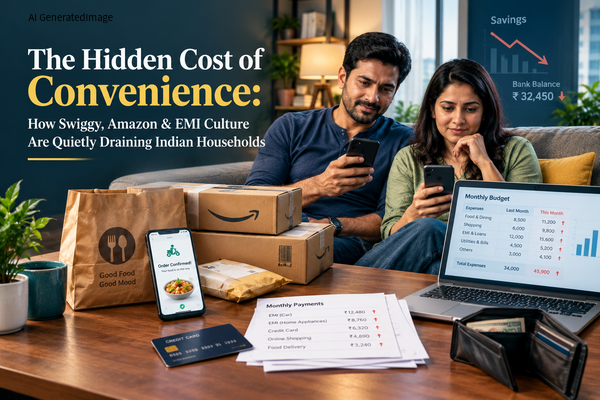
Open your phone right now.
Chances are you have Swiggy, Zomato, Amazon, Blinkit and at least one EMI app sitting on your home screen. Dinner is three taps away. So is a new pair of shoes. So is a phone you cannot really afford this month, except you can, because “it’s just ₹2,999 a month.
This is the hidden cost of convenience, and most Indians are paying it without ever noticing the bill.
Nobody sits down and decides “I will overspend this month.” Instead, a dozen small, effortless choices quietly add up. That is exactly how the hidden cost of convenience works. It does not show up as one big number. It hides inside ₹249 here, ₹499 there, and a ₹1,499 EMI you barely remember signing up for.
Why Convenience Feels Free But Rarely Is
India’s digital payments boom has made spending almost frictionless. The RBI has repeatedly pointed to convenience and ease of use as major reasons why UPI and digital payments have grown so fast. That is wonderful news for businesses. It is trickier news for your bank balance.
When paying is instant, thinking becomes optional. You do not pause before a purchase the way you did when you had to walk to a shop, stand in a queue and hand over cash. That pause used to protect people from themselves. Today, that friction is gone, and so is the built-in speed bump that once made you ask, “do I actually need this?”
The problem was never that food delivery or online shopping exist. The problem is convenience quietly turning into a default lifestyle instead of an occasional treat.
The Swiggy Effect and How Small Orders Turn Into Big Bills
Picture a fairly normal week. Monday you are tired, so you order dinner. Wednesday it rains, so you order again. Friday feels like it deserves a treat. Sunday nobody wants to cook.
Each decision feels harmless on its own. But order food even 10 times a month at an average of ₹400 per order, and you are looking at ₹4,000 a month, or roughly ₹48,000 a year, just on delivery.
Then there is the app itself working against your discipline. You log in for a ₹280 dinner, and suddenly you see “free delivery above ₹499” or “20% off on orders above ₹599.” Your bill jumps to ₹540 because you wanted to “save” ₹100. That is not a discount. That is clever marketing dressed up as one, and this small trick is a big part of the hidden cost of convenience.
Amazon and the "I Might Need It" Trap
Amazon and quick commerce apps solved a real problem. You no longer need to visit five shops to compare prices or wait days for something to arrive. That is genuinely useful.
But this same convenience quietly removes the friction that once protected your wallet. Earlier, buying something meant leaving the house, comparing options and physically carrying it home. Today you can buy a gadget while lying in bed at midnight.
A ₹1,499 impulse buy rarely travels alone. Add a ₹1,999 purchase two weeks later, then ₹799, then ₹2,499, and you have quietly spent close to ₹6,700 without a single purchase feeling “big enough” to question. That is Amazon impulse buying at its most dangerous, not one large mistake, but many small ones stacked together.
Quick commerce apps like Blinkit, Zepto and Instamart add another layer to this. Ten-minute delivery removes the last bit of planning from grocery shopping. Instead of one weekly trip with a fixed list, you order milk on Monday, snacks on Wednesday and “just one more thing” on Friday. Each order carries its own delivery or handling charge, and the total quietly overtakes what a planned trip would have cost. This is the hidden cost of convenience showing up in the most ordinary purchases, the ones that never even feel like shopping.
EMI Culture and When "Affordable" Becomes a Trap
Perhaps the most dangerous sentence in personal finance today is “it’s only ₹3,999 a month.” That is not the price of the product. That is the monthly instalment. If you are buying a ₹1.2 lakh phone on EMI at ₹5,000 a month, you have still bought a ₹1.2 lakh phone. You have simply broken the pain into smaller, easier pieces. This is where EMI stacking quietly becomes dangerous. One EMI feels manageable. Three still feel fine. But look at how quickly it adds up:
Purchase Monthly EMI
Smartphone ₹4,000
Laptop ₹3,500
Furniture ₹4,000
Vacation package ₹5,000
Electronics ₹2,500
Total ₹19,000
That is ₹19,000 committed every single month before groceries, rent, insurance or your SIP. The RBI’s guidelines on retail lending and household indebtedness exist precisely because repayment obligations that consistently reduce disposable income create real financial stress. EMI culture does not make anything cheaper. It just makes future income look already spent.
The Real Cost Is Behavioural, Not Just Financial
Here is the part people miss. Convenience spending does not just drain your account, it changes how you think about money.
“I have ₹50,000 in my account” and “I have ₹50,000 left after my SIP, bills, EMIs and goals” describe the same balance, but they lead to very different decisions. The first invites spending. The second invites planning.
This shift is also how lifestyle inflation quietly creeps in. Cooking five days a week slowly becomes ordering four times a week. A weekly market trip becomes ordering groceries the moment anything runs out. Saving first, then spending, flips into spending first and saving whatever is left. None of this feels dramatic in the moment, which is exactly why it is so easy to miss.
The Opportunity Cost Nobody Talks About
Every rupee spent today is a rupee that never gets the chance to grow. If you redirected just ₹5,000 a month from convenience spending into a SIP earning an assumed 12% annually, that amount could grow to roughly ₹11.6 lakh over 10 years. This is only an illustration, not a guaranteed return, but the principle matters more than the exact figure.
That ₹5,000 is not just money you spent. It is also money that never got the chance to compound. That gap between what you spent and what you could have built is the truest measure of the hidden cost of convenience.
How to Take Back Control Without Giving Up Convenience
The goal is not to delete every app or feel guilty over dinner. The goal is spending on purpose instead of spending on autopilot.
Run a 30-day convenience audit. Check your bank statement for food delivery, quick commerce, cabs, subscriptions and EMIs. Add up the monthly total instead of looking at each transaction alone. ₹300 looks harmless. ₹12,000 usually does not.
Set a convenience budget. Decide on a fixed monthly amount, say ₹5,000, for food delivery, online shopping and small indulgences. Once it is used up, you are done for the month. This gives you permission to enjoy convenience without guilt, within a clear boundary.
Use the 10-minute rule. Before any unplanned purchase, close the app and wait 10 minutes. Most impulse buying is driven by boredom or instant gratification, not real need. A short pause is often enough to break that pattern.
Redirect what you save. Do not just “spend less” and stop there. Send that ₹3,000 you saved straight into a SIP, and that ₹2,000 into an emergency fund. Give every saved rupee a job, or it quietly finds its way back into another convenience purchase.
Final Thoughts
Swiggy, Amazon and EMIs are not the enemy. They are tools that make life genuinely easier when used with intention. The hidden cost of convenience only shows up when these tools stop being occasional choices and quietly become your financial default.
Wealth rarely disappears through one big mistake. It disappears through hundreds of small, effortless ones that never felt important enough to question. Budget for convenience instead of eliminating it, understand the true impact of your EMIs, and let apps serve your goals instead of quietly deciding them for you.
The real luxury is not a 10-minute delivery. It is the freedom to spend ₹500 without worrying about it, because your money already has a plan.
Start small. Track one week of your spending, spot where the hidden cost of convenience is showing up in your own life, and fix just one habit. That single change, repeated month after month, is often what separates people who feel constantly short on money from those who feel genuinely in control of it.
FAQs
What is the hidden cost of convenience?
The hidden cost of convenience is the extra money you spend because something is easy, fast, or instantly available. Food delivery, quick-commerce orders, online shopping, subscriptions, and EMIs may seem affordable individually, but frequent use can significantly increase your monthly expenses and reduce your ability to save and invest.
Is ordering food from Swiggy or Zomato bad for your finances?
How does Amazon encourage impulse spending?
Are EMIs bad for personal finance?
Why does EMI culture make expensive purchases feel cheaper?
EMIs change how we perceive the cost of a purchase. A ₹1,20,000 product can feel expensive, while “₹5,000 per month” may seem affordable. But the total purchase price hasn’t changed. Looking at the total amount payable, including interest and fees, gives you a better picture of the actual cost.
Disclaimer
This article is for educational and informational purposes only and should not be considered financial, investment, tax, or legal advice. Please consult a qualified financial advisor before making any financial decisions.