
Financial Stress Reduction Plan in 10 Proven Steps
Build a financial stress reduction plan that actually works. Learn 10 simple steps to cut debt, build an emergency fund and feel in control of your money
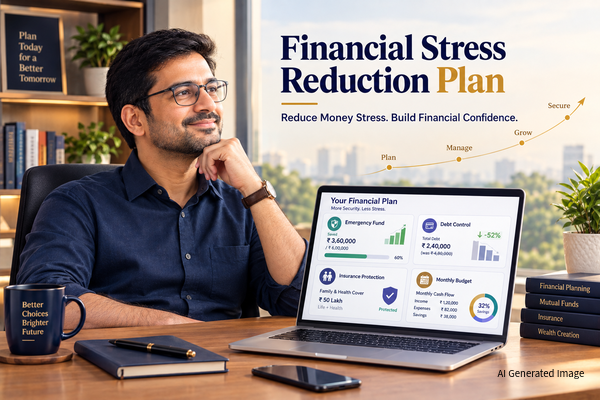
Money stress does not always come from a low salary. Someone earning ₹40,000 a month can feel calm, while someone earning ₹2 lakh can feel trapped. The real culprit is usually uncertainty, not income.
That is exactly what a financial stress reduction plan fixes. It shows you where your money goes, protects you from sudden shocks and gives you a clear direction. You do not have to give up things you enjoy. You just need a system.
Let’s build your financial stress reduction plan step by step.
What Is a Financial Stress Reduction Plan?
A financial stress reduction plan is a practical system for managing money so that surprises hurt less. It covers five areas.
- Controlling monthly expenses
- Managing and reducing debt
- Building an emergency fund
- Buying the right insurance
- Creating a realistic savings and investment plan
Think of your financial stress reduction plan as a safety net. You build it so one bad event does not wipe out years of progress.
Why Does Money Create So Much Stress?
Picture a person earning ₹1.5 lakh a month. Their home loan EMI is ₹35,000, car EMI ₹20,000, credit card payments ₹15,000, lifestyle spending ₹40,000 and family commitments ₹20,000. Only ₹20,000 is left. Now imagine a three-month job loss. Suddenly the problem is not income. It is the lack of flexibility.
This is why a good financial stress reduction plan is not only about growing wealth. It is about reducing your vulnerability.
10 Steps to Build Your Financial Stress Reduction Plan
1. Find Your Financial Stress Number
Every financial stress reduction plan starts with one number. Add up only your essential monthly costs. Leave out shopping, holidays and entertainment.
Expense Monthly Amount
Home loan or rent ₹25,000
Groceries ₹12,000
Utilities ₹5,000
School fees ₹10,000
Transportation ₹5,000
Insurance ₹4,000
Other essentials ₹9,000
Your financial stress number here is ₹70,000 a month. You will need it to size your emergency fund.
2. Create Some Breathing Room
Say your income is ₹1,00,000, essentials cost ₹60,000 and EMIs take ₹15,000. The remaining ₹25,000 is your breathing room. Use it for emergency savings, investments, debt repayment or guilt-free spending.
The rule is simple. Never let your whole salary disappear before the next one arrives.
3. Build an Emergency Fund First
Cars break down and relatives fall sick. Without a cushion, you end up borrowing at the worst possible time.
A common target is 3 to 6 months of essential expenses. On a ₹70,000 stress number, that means ₹2.1 lakh to ₹4.2 lakh. Freelancers, business owners and people with dependents may want a bigger buffer.
You do not need the full amount overnight. Start with ₹25,000, then ₹50,000, then ₹1 lakh. Keep the money in a savings account or a sweep-in fixed deposit, because safety and quick access matter more than returns here.
4. Stop Treating Credit Cards Like Extra Income
If you earn ₹80,000 but spend ₹95,000 every month, your card is quietly filling a ₹15,000 gap.
The cost is steep. Credit card interest in India usually runs between 2.5% and 4% a month, which works out to roughly 30% to 48% a year. Paying your full statement amount by the due date means no interest on purchases.
If you already carry debt, list it all in one place.
Debt Outstanding Interest Level EMI
Credit card ₹80,000 Very high ₹8,000
Personal loan ₹3 lakh Medium to high ₹10,000
Car loan ₹6 lakh Lower ₹15,000
Then clear the highest-interest debt first. Seeing everything together turns a vague worry into a fixable number.
5. Trim Your Fixed Commitments
Subscriptions are easy to cancel. A large EMI is not. Before taking any new loan, ask yourself, “Will this EMI still feel comfortable if my income falls?”
Loan approval tells you what you can borrow, not what you can afford. As a common guideline, try to keep all your EMIs within about 40% of your take-home pay.
6. Protect Your Income
Your income is probably your biggest asset. At ₹1 lakh a month, you could earn around ₹3.6 crore over 30 years, even before raises. Yet many people insure phones and cars but not their earning power.
Review these covers.
- Health insurance
- Term life insurance
- Personal accident cover
- Business insurance, if you run one
Treat insurance as protection, not as an investment. A popular rule of thumb for term cover is 10 to 15 times your annual income, and some planners suggest 15 to 20 times for younger earners, but your dependents, loans and savings should decide the final figure.
7. Automate Your Savings
8. Separate Your Goals
One giant bucket for every goal creates confusion. Split them by time.
- Short term goals, such as a holiday, annual insurance premium or home repairs
- Medium term goals, such as a car, higher education or a home down payment
- Long term goals, such as retirement or your children’s education
9. Create a Bad Month Budget
Most budgets assume a perfect month. Ask yourself what you would cut if your income dropped by 20% to 30%.
Decide in advance what must continue, such as rent or EMI, food, utilities, insurance, school fees and medical costs. Then decide what can be reduced, such as eating out, shopping, travel and subscriptions. Finally, list what can pause, such as luxury purchases and upgrades.
10. Review Your Plan Regularly
Where Did the Missing ₹30,000 Go?
A family earns ₹1,50,000 a month. Essentials take ₹70,000, EMIs ₹25,000 and lifestyle ₹20,000. That leaves ₹35,000, yet they save only ₹5,000. About ₹30,000 is leaking somewhere.
Tracking a month of spending reveals ₹8,000 on eating out, ₹5,000 on shopping, ₹4,000 on subscriptions, ₹6,000 on impulse buys and ₹7,000 on miscellaneous items.
Before chasing high returns, they now have something more valuable, awareness. The first investment in any financial stress reduction plan is often simply knowing where your money goes.
Use the 24-Hour Rule for Big Purchases
What If Your Income Is Irregular?
Freelancers, consultants and business owners should not plan around their best month. If your average is ₹1,20,000 but a weak month brings ₹80,000, build your essential lifestyle around the lower number. Send the extra from strong months to emergency savings, taxes and investments. This keeps your financial stress reduction plan steady even when income swings.
Final Thoughts
Financial stress rarely disappears just because you earn more. Real peace comes from margin, protection and clarity.
So start small. Build an emergency fund, control expensive debt, protect your income and automate your savings. Then review the plan regularly.
Pick one number, one problem and one improvement this weekend. Your financial stress reduction plan will grow from there.