
How to Balance Spending and Saving Without Guilt
Table of Contents
Learn how to balance spending and saving without guilt using practical budgeting tips, mindful spending habits, and realistic financial planning for long-term wealth.
Have you ever bought something you genuinely enjoyed, only to spend the next three days feeling terrible about it?
Or maybe you have gone the other way cutting every expense, skipping meals out, refusing to spend on anything beyond the bare minimum only to feel exhausted and eventually blow your budget in one impulsive weekend.
Both extremes are more common than you think. And both are signs that your relationship with money needs a reset.
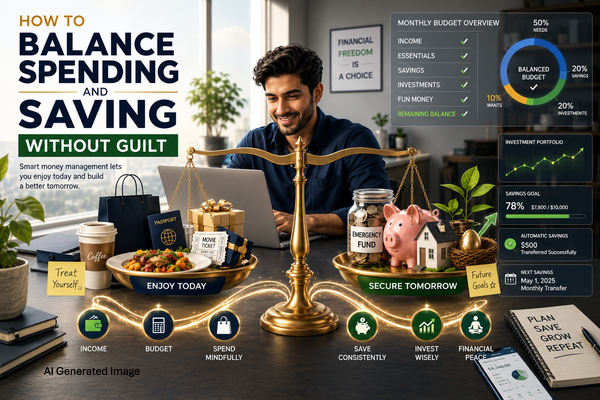
The truth is, learning to balance spending and saving is not about choosing between enjoying life today and securing your future. It is about giving both the right place in your financial plan so neither one suffers.
Why Financial Guilt Happens
Financial guilt rarely comes from the amount you spent. It almost always comes from uncertainty.
When there is no plan, every purchase feels like a mistake. You do not know if you have saved enough this month, whether your emergency fund is adequate, or if you are on track for your goals. So even reasonable spending triggers anxiety.
Common reasons people feel guilty about spending include having no monthly budget, comparing their lifestyle to others on social media, fear of future financial emergencies, and carrying regret from past money mistakes.
The fix is not to stop spending. The fix is to spend with a plan behind it.
Start With the "Save First, Spend Later" Habit
One of the most practical money habits you can build is automating your savings before you spend a single rupee on lifestyle expenses.
Most people save whatever is left at the end of the month. The problem is there is rarely anything left.
Instead, set up an automatic transfer to your savings or investment account on the day your salary arrives. Even a 20% savings rate is a solid starting point.
Here is a simple structure that works well for a monthly income of Rs 60,000.
Savings and investments get Rs 12,000 (20%). Fixed essential expenses like rent, groceries, and utilities take Rs 30,000 (50%). Lifestyle spending — dining out, entertainment, subscriptions — gets Rs 18,000 (30%).
Whatever falls in that lifestyle bucket is yours to spend without guilt. You have already handled your future. The rest belongs to your present.
Build a Budget That Actually Includes Fun
Most budgets fail because they are built like punishment. Every rupee is accounted for in the most boring, restrictive way possible, and the moment you slip up, the whole plan feels ruined.
A smarter approach is to include a dedicated guilt-free spending category from day one.
A practical monthly allocation could look like this. Savings and investments take 20%. Essential expenses like rent, utilities, and food take 50%. Lifestyle and entertainment get 20%. Personal growth courses, books, health gets the remaining 10%.
When you have already earmarked money for fun, spending it does not feel reckless. It feels intentional. That shift in mindset changes everything.
Spend According to Your Values, Not Your Instagram Feed
Here is something most personal finance advice skips not all spending creates the same level of satisfaction.
Research in behavioral economics consistently shows that spending aligned with your personal values tends to deliver far greater long-term happiness than purchases driven by comparison or social pressure.
Ask yourself honestly before any significant purchase will this improve my daily life, does this reflect something I genuinely care about, and will I still feel good about this six months from now?
Someone who loves travel may get far more joy from a budget trip to Coorg than from buying an expensive smartwatch. Someone else might find deep value in enrolling in a skill-development course rather than upgrading their wardrobe.
The goal is to spend more on what genuinely matters to you and less on everything else. When your spending reflects your priorities, guilt becomes almost impossible.
Build Your Emergency Fund Before Anything Else
A huge reason people feel anxious about spending is that they have no financial cushion. Every purchase feels risky because any unexpected expense could derail them.
An emergency fund removes that anxiety.
Financial planners in India typically recommend keeping three to six months of essential living expenses in a liquid account for salaried individuals. If you are self-employed or have variable income, the guidance goes up to six to twelve months, depending on how stable your income is and how many dependents you support.
Keep this money in a high-interest savings account or liquid mutual fund. Liquid mutual funds typically settle redemptions within one working day, so the money is accessible quickly when you need it. Once this fund is in place, planned spending becomes genuinely guilt-free because you know you are protected.
Stop Letting One Bad Month Ruin Everything
One of the most damaging money mindsets is the all-or-nothing approach.
“I overspent this month, so the whole budget is ruined.”
That thinking leads people to abandon financial discipline entirely after one slip, which is the same logic that causes someone to eat an entire cake after one biscuit.
Personal finance does not work on perfection. It works on consistency.
If you overspend in March, review what happened, adjust April’s budget, and keep going. One expensive month cannot erase years of disciplined saving and investing. What breaks long-term wealth building is quitting entirely, not stumbling once.
Automate the Boring Stuff So You Do Not Have to Think About It
When saving requires willpower every single month, you will eventually lose. Life gets busy, priorities shift, and the savings transfer that was “definitely happening this week” quietly disappears.
Automation solves this entirely.
Set up standing instructions for your SIP investments, recurring deposits, emergency fund contributions, and any goal-based savings accounts on the same day your salary credits. Modern banking in India makes this simple through NACH mandates, which are managed through NPCI’s National Automated Clearing House infrastructure.
Once the transfers are automated, you are left with a clear spending budget that you can use freely. No mental calculation required.
Practice the 24-Hour Rule for Impulse Purchases
Mindful spending is not about spending less. It is about spending better.
Before any unplanned purchase, build a habit of waiting 24 hours. During that time, ask yourself whether you actually need it, whether you can afford it comfortably within your lifestyle budget, and whether the urge is driven by boredom, stress, or genuine desire.
Most impulse purchases fail this simple test. The ones that pass it are usually worth making.
This single habit can save most people several thousand rupees a month without requiring any sacrifice on what genuinely matters to them.
Celebrate Progress — Even the Small Wins
Wealth-building is a long game. If you only celebrate when you hit a massive milestone, motivation will run dry long before you get there.
Build a habit of recognizing smaller wins. Six consecutive months of consistent SIP investing is worth acknowledging. Paying off a credit card balance is worth a moment of pride. Sticking to your monthly budget three months in a row is real progress.
Celebrating milestones, even modest ones, reinforces the behaviours that create long-term financial success. It also makes the whole process more sustainable and far less miserable.
A Quick Checklist for Balanced Money Management
Save before you spend every single month. Create a realistic monthly budget that includes a fun money category. Build an emergency fund covering at least three to six months of expenses. Automate savings and SIP investments. Apply the 24-hour rule to unplanned purchases. Spend according to your values, not social comparison. Review your finances at the end of each month. Celebrate small milestones consistently.
The Real Goal Is Intentional Living, Not Financial Misery
Balancing spending and saving is not about becoming someone who never spends. It is about becoming someone who spends with intention, saves with consistency, and stops losing sleep over normal financial decisions.
Money is a tool. A good tool makes life easier, not more stressful.
When your savings are automated, your emergency fund is in place, your budget includes room for enjoyment, and your spending reflects what you actually value guilt stops being part of the equation.
That is what a healthy relationship with money looks like. And it is available to anyone willing to build the right habits, one month at a time.