
Lifestyle Inflation The Silent Wealth Killer
Table of Contents
Lifestyle inflation silently eats your savings every time your income rises. Learn the warning signs and simple steps to beat lifestyle creep for good.
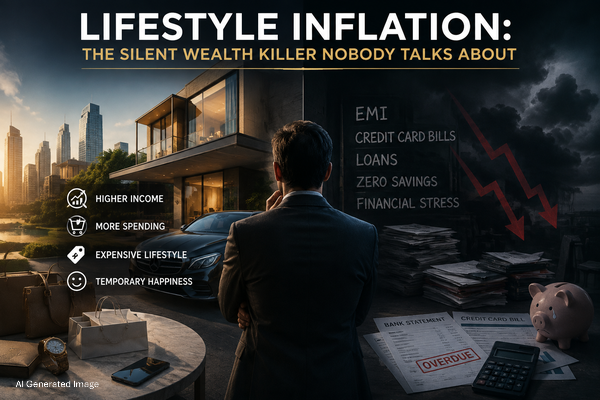
Picture this.
You land a solid appraisal. Your take home jumps by 20%.
The first month feels great. You stop checking prices before ordering food. A new phone finds its way into your cart. Weekend trips start happening more often. A couple of new EMIs creep in without much thought.
None of it feels reckless in the moment.
You’re earning more, so spending a little extra seems fair.
Fast forward a year and your salary slip looks impressive, but your savings account tells a different story.
This is lifestyle inflation, and it is one of the sneakiest ways people delay their own financial freedom.
What Exactly Is Lifestyle Inflation?
Lifestyle inflation, also known as lifestyle creep, happens when your expenses rise in step with your income. Instead of using a raise to strengthen your savings or investments, you quietly use it to fund a more expensive version of your everyday life.
Here’s a simple example.
You earn ₹60,000 a month and spend ₹45,000
Your income grows to ₹80,000.
Logically, your monthly expenses should still hover around ₹45,000, leaving you an extra ₹20,000 to invest. Instead, your spending drifts up to ₹63,000. Your savings grow by a mere ₹2,000.
Where did the remaining ₹18,000 disappear?
Nowhere dramatic. It got absorbed into small, everyday upgrades that felt harmless individually.
How Lifestyle Creep Sneaks Into Your Life
Lifestyle inflation rarely announces itself. It usually builds up through a string of small, reasonable-looking decisions, such as:
- Moving to a costlier rental or a bigger EMI
- Upgrading your car
- Eating out more often
- Booking more frequent holidays
- Buying the latest gadgets
- Stacking up OTT and lifestyle subscriptions
- Choosing premium versions of things you once bought without a second thought
Each choice looks fine on its own. Stacked together, they can quietly rewrite your entire financial future.
Why This Habit Is So Costly
The real danger of lifestyle inflation is not the spending itself. It is that many of these upgrades become permanent monthly commitments.
A pricey dinner is a one-time expense. A jump in rent is not. A bigger car does not just mean a higher EMI, it also brings higher insurance, fuel and maintenance costs. A larger home adds furnishing, upkeep and utility bills that stay with you for years.
What starts as a temporary income boost can quietly turn into permanent financial pressure.
7 Warning Signs Lifestyle Inflation Is Draining Your Wealth
You do not need to be a big spender for lifestyle inflation to affect you. Watch for these signs.
1. Your income keeps rising, but your investments barely move. More money should create more financial capacity, not just more spending capacity.
2. Your wants have quietly become needs. That basic phone that once worked fine now feels outdated. Eating out twice a week has replaced the occasional treat.
3. Your fixed costs keep climbing. Rent, car EMI, school fees, subscriptions and memberships all add up. The more fixed commitments you carry, the less breathing room your salary provides.
4. You could not comfortably survive on your old salary. If dropping back to your previous income feels impossible, your lifestyle has likely outgrown your financial cushion.
5. Every bonus is spent before it even arrives. If your annual payout already has a holiday or gadget attached to it mentally, you are spending future money in advance.
6. You have more EMIs than investments. Small monthly commitments add up fast. Five EMIs of ₹18,000 each quietly become ₹90,000 a month.
7. You feel wealthy on payday and stretched by month end. A rising income has simply created a more expensive cycle instead of real financial freedom.
The Hidden Cost You Don't See
Here is the part most people overlook. When you spend instead of invest, you don’t just lose that money, you also lose the growth it could have generated.
Suppose a raise gives you an extra ₹20,000 every month, and you spend all of it instead of investing. That is ₹2.4 lakh a year gone.
Invested consistently at a hypothetical 10% annual return, ₹20,000 a month could grow to roughly ₹82.9 lakh over 15 years. Actual returns vary and are never guaranteed, but the illustration makes the point clearly.
Lifestyle inflation does not just consume today’s money. It quietly consumes tomorrow’s wealth too.
Why a High Income Doesn't Automatically Mean You're Wealthy
A common myth in personal finance is that high income equals wealth. It does not.
A more useful formula looks like this.
Income minus spending equals savings.
Savings, combined with time and consistent investing, is what builds real wealth.
Someone earning ₹3 lakh a month and spending ₹2.9 lakh may actually have less financial flexibility than someone earning ₹1.5 lakh who consistently invests a meaningful share of it. Income creates potential. Your habits decide what actually happens with it.
How to Avoid Lifestyle Inflation Without Feeling Restricted
The goal is not to stop enjoying your money. It is to stop letting every income bump get fully absorbed into spending.
Give every raise a job. Before you spend a fresh increment, decide where it goes. A simple split like 50% investments, 30% goals or debt repayment and 20% lifestyle works well for many people.
Increase savings before increasing spending. Automate your investment amount the moment your salary lands, rather than waiting to see what is left over.
Create a lifestyle upgrade budget. Set aside a fixed portion of any raise purely for enjoyment, so you can treat yourself without letting the entire hike vanish.
Watch your fixed costs closely. Before signing up for a new EMI, ask whether you will still want that commitment three years from now.
Upgrade one thing at a time. You do not need a bigger house, a new car and the latest phone all in the same year just because your income grew.
Hold onto a few old habits. Making coffee at home or sticking with a car that still runs well are small choices that quietly protect your savings rate.
Build an emergency fund. A solid buffer reduces the temptation to rely on debt when unexpected expenses show up.
A Simple Rule Worth Remembering
Your lifestyle does not need to grow at the same speed as your income.
If your salary rises by 20%, your spending does not need to follow at the same pace. Let your lifestyle improve, but let your financial security improve faster.
Already Feeling the Effects of Lifestyle Creep?
If this sounds a little too familiar, there is no need to panic.
Start by reviewing your actual bank and card statements rather than guessing. Sort expenses into essential, important, optional and unnecessary categories. Focus first on the biggest recurring costs, not the small ones. Set a clear savings percentage and automate it. Most importantly, redirect your next raise into investments before your lifestyle absorbs it. Reviewing this every six months helps keep old habits from creeping back in.
The Real Goal Isn't a Smaller Life
Personal finance is not about cutting every small joy out of your life. The better question to ask is whether your spending genuinely supports the life you want, rather than just the life that feels available because your income went up.
A bigger house or a better car is not automatically wrong if it fits your goals and does not derail your financial plan. What matters is intention, not the price tag.
Final Thoughts
A salary hike feels like a win, and it should. But the real win isn’t just earning more, it is what that extra income lets you do. More investments. More security. More freedom to switch jobs, handle emergencies or simply breathe easier at the end of the month.
Lifestyle inflation quietly takes those choices away by convincing you that earning more automatically means spending more.
It does not have to.
The next time your income rises, celebrate it, enjoy a part of it, and then make sure your future self gets paid first. That, more than any paycheck, is what real financial freedom looks like.