
Mutual Fund Portfolio for Conservative vs Aggressive Investors
Table of Contents
Compare mutual fund portfolio for conservative vs aggressive investors strategies. Learn how to build the right mutual fund portfolio, asset allocation tips, and SIP guidance for 2026.
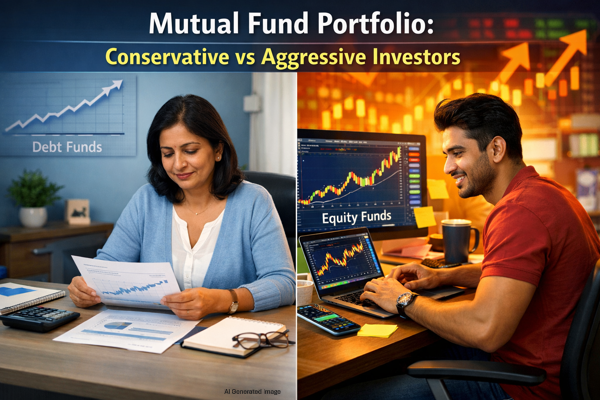
Picking a mutual fund portfolio is one of those decisions that sounds simple until you actually sit down to do it. Should you go for stability or growth? Debt funds or equity funds? SIP or lump sum?
Here is the honest truth: there is no single best mutual fund portfolio. There is only the one that fits your risk appetite, your investment horizon, and your financial goals. This guide breaks it all down in plain language, so you can stop second-guessing and start investing with clarity.
Understanding Investor Types
Before you pick a single fund, you need to know which investor category you fall into. Most investors are either conservative, aggressive, or somewhere in the middle.
Conservative Investor
A conservative investor puts capital protection above everything else. The goal is not to get rich fast. The goal is to grow steadily without losing sleep over market swings.
This type of mutual fund portfolio suits retirees, first-time investors, or anyone who cannot afford a sudden dip in their savings. Think of it as the “slow and steady wins the race” approach.
Key priorities: capital safety, stable returns, low volatility.
Aggressive Investor
An aggressive investor is willing to accept short-term losses for the possibility of much higher long-term returns. The keyword here is “long-term.” Chasing quick gains with an aggressive mutual fund portfolio is how most people end up losing money.
This approach works best for young professionals, salaried investors in their 20s and 30s, or anyone with a 10-plus year investment horizon.
Key priorities: long-term wealth creation, high growth potential, strong tolerance for volatility.
Asset Allocation: The Real Game Changer
Ask any seasoned financial planner and they will tell you the same thing: it is not which fund you pick, it is how you divide your money between asset classes that makes the real difference.
This concept is called asset allocation, and it is the backbone of any strong mutual fund portfolio.
Investor Type – Conservative
Equity Funds – 20% to 40%
Debt Funds – 50% to 70%
Hybrid/Other – 10% to 20%
Investor Type – Aggressive
Equity Funds – 70% to 90%
Debt Funds – 10% to 20%
Hybrid/Other – 0% to 10%
Mutual Fund Portfolio for Conservative Investors
A conservative mutual fund portfolio is built around one core idea: protect what you have while earning a reasonable return.
Suggested Allocation
The bulk of a conservative portfolio, roughly 50 to 70 percent, goes into debt funds. Within that, you can choose from liquid funds, short duration funds, and corporate bond funds depending on your liquidity needs and time horizon.
The next chunk, around 20 to 30 percent, goes into hybrid funds. Conservative hybrid funds and balanced advantage funds are solid choices here because they provide some equity exposure without taking on full market risk.
The remaining 10 to 20 percent can go into equity funds. Large cap funds and index funds are the safest options within this category.
Important Reality Check
A lot of investors assume debt funds are completely risk-free. They are not. Debt funds are subject to interest rate risk and credit risk, especially if the underlying portfolio holds lower-rated bonds. During periods of rising interest rates, even short-duration debt funds can see a temporary dip in NAV.
Sample Conservative Portfolio (Rs 10 lakh)
- Rs 6,00,000 into debt funds
- Rs 2,50,000 into hybrid funds
- Rs 1,50,000 into equity funds
When This Strategy Works Best
This mutual fund portfolio is ideal if your investment horizon is below five years, if you need relative stability over high returns, or if volatile markets genuinely stress you out. There is no shame in admitting that. Knowing your limits is actually one of the smartest things an investor can do.
Mutual Fund Portfolio for Aggressive Investors
An aggressive mutual fund portfolio is designed for long-term wealth creation. The trade-off is that your portfolio will go through phases of sharp decline before recovering and growing.
Suggested Allocation
The lion’s share of an aggressive portfolio, between 70 and 85 percent, goes into equity funds. Within equity, you spread across large cap funds for stability, mid cap funds for growth, and small cap funds for higher return potential.
The debt allocation is kept lean, around 10 to 20 percent, primarily in short duration funds and liquid funds. This portion acts as a buffer during market corrections and provides liquidity if you need quick access to funds.
International funds are optional, but worth considering for global diversification. Keep this allocation small, ideally not more than 5 to 10 percent.
Important Reality Check
Small cap funds can fall sharply and severely during market downturns. Per NSE index data, the Nifty Small cap 250 fell around 44 percent during the 2020 COVID crash, and more than 70 percent during the 2008 global financial crisis. Even in a relatively milder year like 2022, the index dropped around 27 percent. If you panic and redeem during such phases, you lock in losses and miss the recovery entirely. This is why an aggressive mutual fund portfolio only makes sense if you genuinely have the patience and financial stability to stay invested for at least seven to ten years.
Equity portfolios can also take multiple years to recover after major corrections, as seen during market crashes in 2008 and 2020.
Tax Note on International Funds
Tax rules on international mutual funds changed significantly from April 1, 2025. Until March 31, 2025, most international funds were taxed like debt funds, which was a major disadvantage. From FY 2025-26 onwards, international equity funds and Fund of Funds (FOFs) investing overseas have a separate tax treatment. Gains held for more than 24 months qualify as Long Term Capital Gains and are taxed at 12.5 percent flat. Gains redeemed before 24 months are taxed as Short Term Capital Gains at your applicable income tax slab rate.
This is a more favorable structure than before, but the 24-month holding requirement is longer than domestic equity funds, which qualify for LTCG after just 12 months. Factor this in before adding international funds to your mutual fund portfolio.
Sample Aggressive Portfolio (Rs 10 lakh)
- Rs 7,50,000 into equity funds
- Rs 1,50,000 into debt funds
- Rs 1,00,000 into international or hybrid funds
When This Strategy Works Best
This mutual fund portfolio works best when your investment horizon is seven to ten years or more, when you have a stable income and no major financial obligations in the near term, and when your primary goal is long-term wealth creation for retirement or a major life milestone.
Time Horizon Matters More Than You Think
One mistake investors commonly make is choosing a mutual fund portfolio based on expected returns without factoring in time horizon. Here is a simple framework to guide you:
- Less than 3 years: Stay away from equity. Focus entirely on debt funds.
- 3 to 5 years: You can take limited equity exposure, roughly 10 to 30 percent.
- 5 to 10 years: A balanced approach with moderate equity works well.
- 10 years and above: An equity-heavy mutual fund portfolio makes the most sense.
The longer your time horizon, the more market volatility you can absorb, and the higher the probability that equity returns will work in your favour.
Don't Ignore Inflation
This is a trap that conservative investors fall into quite often. You park everything in debt funds, earn a predictable return, and feel secure. But if your mutual fund portfolio is generating returns that barely exceed inflation, your real purchasing power is not growing.
The Reserve Bank of India targets a CPI inflation rate of 4 percent, a mandate confirmed and extended through March 2031. Many conservative debt funds have historically returned in the range of 6 to 8 percent per annum over the medium term. The margin after accounting for inflation and taxes can be thin, especially if your debt fund portfolio leans toward liquid or overnight funds at the lower end of the return spectrum.
This is exactly why even a conservative mutual fund portfolio needs at least some equity exposure. It does not have to be aggressive. But completely avoiding equity over a long horizon is a risk in itself.
Emergency Fund Comes First
Before you build any mutual fund portfolio, make sure your emergency fund is in place. This means setting aside six to twelve months of living expenses in a liquid fund or a savings account.
This emergency corpus should sit separately from your investment portfolio. It should not be touched for investments, and it should be accessible at short notice.
Common Mistakes to Avoid
Even experienced investors make these errors. Keep this list handy:
- Copying a friend’s or relative’s mutual fund portfolio without checking if it fits your own goals
- Investing heavily in small cap funds without understanding how volatile they can get
- Ignoring asset allocation and chasing last year’s top-performing funds
- Not reviewing your mutual fund portfolio at least once a year
- Panicking and redeeming during market downturns, which locks in losses
Rebalancing: The Missing Discipline
Here is something most investors skip: rebalancing.
Over time, market movements shift your original allocation. If equity markets rally sharply, your equity portion may grow from 30 percent to 50 percent of your portfolio without you adding a single rupee. This means you are now taking more risk than you originally intended.
Review your mutual fund portfolio every six to twelve months. If your asset allocation has drifted significantly from your target, rebalance by trimming the overweight asset class and adding to the underweight one.
SIP: Works for Every Investor
Whether you are building a conservative or an aggressive mutual fund portfolio, a Systematic Investment Plan (SIP) is your best friend.
SIP removes the temptation of timing the market, which almost no one gets right consistently. It averages out your cost of investment over time, reduces the emotional pressure of investing a large lump sum, and builds a disciplined savings habit.
Both conservative and aggressive investors benefit from SIP. The only difference is which funds you direct that SIP into.
Conservative vs Aggressive: Which One is Right for You?
There is genuinely no right or wrong answer here. The right mutual fund portfolio is the one you can stick with through market ups and downs without making emotional decisions.
Choose a conservative mutual fund portfolio if peace of mind matters more to you than chasing the highest returns.
Choose an aggressive mutual fund portfolio if you have time, patience, and financial stability to ride out volatility for long-term growth.
Many investors are moderate, somewhere between these two. A 40 to 60 percent equity allocation with the rest in debt and hybrid funds works well for a large number of people.
Final Thoughts
A well-built mutual fund portfolio is not about finding the hottest fund on the market right now. It is about getting your asset allocation right, staying consistent through market cycles, and reviewing your strategy periodically.
Start with a mutual fund portfolio that genuinely reflects your comfort level and your financial goals. Invest regularly through SIP. Rebalance annually. And resist the urge to change everything every time the market moves.
That is really how long-term wealth gets built. One disciplined month at a time.