
The Psychology of Spending: Why You Overspend Without Realizing
Table of Contents
Overspending is not about discipline. It is about how your brain works. Discover the hidden psychology of spending and practical ways to finally take control of your money.
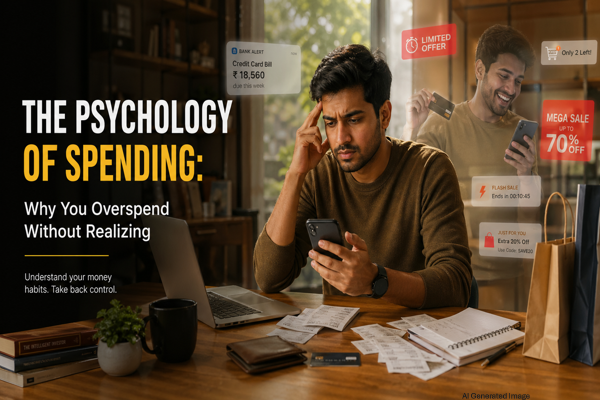
You open your bank app at the end of the month, stare at the balance, and think, “Where did it all go?”
No major purchases. No emergencies. Yet somehow, the money just… disappeared.
If that sounds familiar, you are not alone. And more importantly, it is not your fault.
Overspending is not a discipline problem. It is a brain problem. The way your mind processes money, decisions, and rewards works against you every single day. The field of behavioral finance, built on decades of research by Nobel laureates like Richard Thaler (Nobel Prize, 2017) and Daniel Kahneman (Nobel Prize, 2002), has proven this over and over again.
Once you understand the psychology of spending, everything changes. You stop feeling guilty and start making smarter decisions.
Let us walk through exactly what is happening inside your head.
Why Overspending Happens (Even If You Are "Good With Money")
Traditional money advice loves to say “make a budget and stick to it.” But budgets alone do not work for most people because they ignore the root cause. Real-world spending behavior is driven almost entirely by psychology, not math.
Here are the eight hidden forces that quietly drain your bank account.
1. The "Small Purchases Don't Matter" Trap
A quick Swiggy order. A cab upgrade. A sale item you did not plan to buy.
Each of these feels completely harmless. After all, it is just a couple hundred rupees, right?
Wrong. Your brain is looking at each purchase individually and failing to add them up. This is called “mental accounting,” a concept developed by Nobel laureate Richard Thaler. His research showed that people mentally separate money into categories and judge each transaction in isolation, rather than seeing the full cumulative picture.
Here is what the math actually looks like:
Spending just Rs. 300 per day on small impulse purchases, across 15 to 20 days a month, comes to Rs. 4,500 to Rs. 6,000 every month. Over a full year, that is Rs. 54,000 to Rs. 72,000.
That is a vacation. Or a meaningful investment. Gone on things you barely remember buying.
Track your spending by category, not just as a total. Grouping things like food delivery, impulse online buys, and convenience upgrades will show you the real picture fast.
2. Instant Gratification vs Future You (Present Bias)
Your brain values something you can have right now far more than the same thing available in the future. Behavioral economists call this “present bias,” and it is one of the most powerful forces in personal finance psychology.
Buying a new pair of shoes today feels exciting, real, and rewarding. Saving that money for a goal three years away feels abstract and easy to skip.
The problem is that “Future You” has to live with every spending decision “Present You” makes.
One of the most effective ways to fight present bias is to give your savings goals specific names. “Emergency Fund,” “Goa Trip 2026,” or “New Laptop Fund” are all more motivating than a generic savings account. When the future feels real, your brain treats it as a real priority.
3. Digital Payments Reduce the "Pain of Paying"
When you pay with cash, you feel it. You physically hand money over. Your brain registers a small sense of loss, which naturally puts a brake on impulsive spending.
Digital payments and credit cards remove that friction entirely, and then some.
MIT Sloan professor Drazen Prelec has spent decades studying exactly how payment methods affect spending behavior. His landmark 2001 study with colleague Duncan Simester found that people were willing to bid nearly twice as much for the same item when paying by credit card compared to cash. More recent research by Prelec and colleagues, published in 2021, found through brain imaging that credit card purchases actively stimulate the brain’s reward networks, effectively “stepping on the gas” and creating a genuine craving to spend, beyond simply removing discomfort.
In short: cards and digital payments do not just make spending feel less painful. They make spending feel rewarding. That is a meaningfully stronger force to be aware of.
This does not mean you need to carry cash everywhere. But reviewing your expenses weekly instead of monthly, and avoiding stored one-click payments for non-essentials, can restore some of that healthy friction.
4. Lifestyle Inflation (Lifestyle Creep)
You get a raise. Suddenly you are eating at nicer restaurants, upgrading your phone, and booking better hotel rooms on trips.
Each choice, taken alone, seems perfectly reasonable. You earned more, so you can afford more.
But when your expenses rise at the same pace as your income, your wealth never actually grows. This pattern is called lifestyle inflation or lifestyle creep, and it is one of the most common traps for salaried professionals.
A practical rule that works: when your salary increases by 20 percent, allow your lifestyle expenses to increase by a maximum of 10 percent. The remaining difference goes directly into savings or investments. Over time, this gap between income growth and expense growth is what actually builds financial security.
5. Emotional Spending: You Are Not Buying, You Are Coping
Think about the last time you made an unplanned purchase. Were you bored? Stressed? Had a rough day at work and felt like you deserved a treat?
Emotional spending is real, extremely common, and rarely talked about in personal finance. You are not buying a product. You are buying temporary relief from an emotion.
The challenge is that the relief is short-lived. The expense, however, stays on your statement.
Before any non-essential purchase, pause and ask yourself one honest question: “What am I actually feeling right now?” If the answer has nothing to do with the product itself, wait 24 hours. That gap between the emotion and the purchase is often all you need.
6. Social Comparison: The Invisible Pressure to Spend
Your colleague just bought a new car. Your friend posted photos from a European vacation. An influencer you follow is showing off a new gadget.
And suddenly, your perfectly good life starts to feel like it is not enough.
This is social comparison theory in action, first documented by social psychologist Leon Festinger in his 1954 paper published in Human Relations. His research showed that people have a fundamental drive to evaluate their own lives by looking at others, and modern social media has turned this instinct into a 24-hour highlight reel.
The crucial thing to remember is that you are comparing your full, unfiltered reality to someone else’s carefully selected best moments. That comparison is never fair, and it is never accurate.
Define your own financial goals based on what actually matters to your life. Reduce your exposure to content that consistently triggers the urge to spend. Over time, this alone can shift how you make money decisions.
7. Anchoring: How Discounts Trick Your Brain
You see a product listed at Rs. 4,999, now marked down to Rs. 2,999. Your brain immediately locks onto the original price as the reference point, making Rs. 2,999 feel like a bargain.
This cognitive trap is called anchoring bias, first formally described by psychologists Amos Tversky and Daniel Kahneman in their 1974 research on judgment and decision-making. Retailers use it deliberately. The “was” price is the anchor. Everything else is judged relative to it.
But ask yourself this simple question: If this product were always priced at Rs. 2,999 with no discount involved, would you still buy it?
If the answer is no, you were not saving Rs. 2,000. You were spending Rs. 2,999 on something you did not actually want. That is the anchoring trap, and recognizing it is the first step to breaking it.
8. The Subscription Illusion
Rs. 99 a month for one app. Rs. 149 for another. A streaming platform here, a premium membership there.
Each feels trivial. But stack six or eight of these together, and you are looking at Rs. 1,000 to Rs. 2,000 disappearing every single month on services you may barely use. This pattern is widely referred to as subscription creep, and it catches even financially aware people off guard.
The fix is simple: audit your subscriptions every three months. Go through every auto-debit and recurring charge. Cancel anything you have not actively used in the last 30 days. You will almost certainly find money hiding there.
A Simple Framework to Control Overspending
You do not need a complicated budgeting system. You need three things working together.
Awareness Layer: Track your spending weekly, not monthly. Categorize it. Identify where the money actually goes before making any changes.
Friction Layer: Add a 24-hour delay rule for all non-essential purchases. Remove saved payment details from shopping apps. Make spending slightly harder on purpose.
Intentional Spending Layer: Once you know where your money is going, make a conscious choice. Spend more on things that genuinely improve your life. Cut ruthlessly on things that do not.
This framework works because it addresses the psychology of overspending directly, not just the numbers.
The Real Goal Is Not Spending Less. It Is Spending Better.
Overspending is not a character flaw. It is not a sign that you are bad with money. It is a completely predictable response to the way your brain is wired and the environment that has been designed around you.
Once you understand the psychology of spending, the guilt goes away. What replaces it is clarity. You start seeing your decisions for what they are, and you start making better ones without feeling restricted.
Financial success has never been about spending as little as possible. It is about spending in a way that aligns with what you actually want from your life.
Next time you feel the urge to buy something, pause for just a moment and ask: “Is this making my life genuinely better, or is it just satisfying a feeling that will pass in an hour?”
That one question, asked consistently, can save you lakhs over the course of your life.
Final Thought
Next time you feel the urge to buy something, pause and ask:
“Is this improving my life or just satisfying a moment?”
That one question can save you lakhs over time.
FAQs
Why do I overspend even when I know I shouldn’t?
Overspending is rarely about knowledge it’s about behavior. Psychological biases like present bias, emotional spending, and social comparison often override logic. Even if you know what’s right, your brain prioritizes immediate comfort over long-term benefits.
What is the biggest psychological reason for overspending?
One of the biggest drivers is instant gratification (present bias) your tendency to prefer rewards now rather than later. This is why saving feels hard and spending feels easy, even when you have clear financial goals.
Do digital payments really make people spend more?
Yes, in many cases. Research shows that digital payments reduce the “pain of paying,” making transactions feel less tangible. This can lead to higher spending compared to cash, especially for small, frequent purchases.
How can I stop emotional spending?
Start by identifying triggers like stress, boredom, or the need for reward. Then:
- Pause before buying (use a 24-hour rule)
- Replace spending with alternative habits (walk, talk to someone, journaling)
- Track patterns to understand when and why you spend emotionally
What is lifestyle inflation and how do I avoid it?
Lifestyle inflation happens when your expenses increase as your income grows.
To avoid it:
- Increase your savings rate with every salary hike
- Set fixed investment goals before upgrading your lifestyle
Disclaimer
This article is for information and education only. It is not financial advice.
Your financial situation is unique, so before making any decisions, consider your own goals or speak to a qualified financial advisor.
All examples are just for understanding and may not reflect real results.
You are responsible for your financial decisions.