
Why Fear Stops People from Investing
Fear stops people from investing. Fear of investing is costing you more than you think. Discover 5 real investing fears, the hidden cost of waiting, and practical steps to start investing with confidence today.
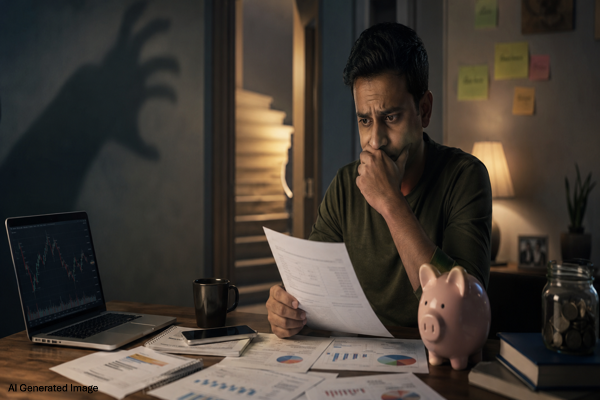
Fear is one of the biggest reasons people delay investing.
Not lack of money. Not lack of intelligence. Not even lack of opportunity.
Just fear.
Think about it. Most people genuinely want financial security. They want a comfortable retirement, a growing savings pool, and long-term wealth for their family. But the moment it actually comes time to put money into the market, something shifts. Uncertainty creeps in, doubts pile up, and before they know it, another year has passed without a single rupee invested.
“What if I lose money?”
“What if the market crashes right after I start?”
“What if I pick the wrong fund?”
So they wait. And waiting has a very real, very painful cost that most people never calculate.
Why Investing Feels So Scary
On paper, investing is straightforward. You put money into assets, those assets grow over time, and your wealth compounds. Simple enough.
But in real life, investing feels uncomfortable because of one unavoidable truth: uncertainty. Unlike a fixed deposit or a savings account, investments go up and down. That movement creates emotional pressure that can push even financially aware people into inaction.
The fear of investing is completely normal, especially for first-time investors. The problem is not the fear itself. The problem is when fear turns into a permanent reason to do nothing.
The Hidden Cost of Waiting to Invest
Here is what most people get wrong. They think avoiding the market protects them. But delaying investing does not eliminate risk. It simply trades one risk (market volatility) for another (losing valuable time for compounding).
Compounding is when your returns start earning their own returns. The earlier you start, the longer this cycle runs. A person who starts a monthly SIP of Rs. 5,000 at age 25 will typically accumulate significantly more wealth by retirement than someone who starts the same SIP at 35, even if the late starter contributes for just as many years. The difference is not discipline. It is simply time.
According to data from AMFI (Association of Mutual Funds in India), the number of SIP accounts in India crossed 10 crore in 2024, reflecting growing awareness that consistent, long-term investing beats waiting for the “perfect” moment. Still, millions of potential investors remain on the sidelines, held back entirely by fear.
Inflation quietly compounds against those sitting in cash. The Reserve Bank of India targets 4% CPI inflation, with a tolerance band of 2% to 6%. Money sitting in a savings account at a major bank earning around 2.75% to 3% interest is, in real terms, losing purchasing power every single year. That is the hidden cost of hesitation.
5 Common Fears That Stop People from Investing
1. Fear of Losing Money
This is the fear that sits at the top for most people. Investing gets mentally associated with gambling, stock market crashes, and horror stories of people wiping out their savings overnight. Those images stick.
But long-term investing in diversified assets is fundamentally different from short-term speculation. The Nifty 50, India’s benchmark equity index, has delivered an approximate 20-year CAGR of around 11% despite going through the 2008 global financial crisis, the COVID-19 crash of 2020, and multiple corrections in between. Past returns do not guarantee future performance, but history does show that diversified, patient investing has rewarded long-term investors far more often than it has punished them.
What actually helps: Start with a small amount you can emotionally afford to keep invested. Diversify across asset classes. Stop watching your portfolio daily. Invest consistently regardless of short-term market movements.
2. Fear of Not Understanding Finance
Financial jargon is genuinely intimidating. Terms like CAGR, expense ratio, alpha, beta, equity allocation, and NAV can make a beginner feel like they need a finance degree before they can start. They do not.
The truth is that successful long-term investing is far more about behavior and consistency than financial knowledge. You do not need to understand options pricing to start a SIP in a diversified equity mutual fund. You do not need to read balance sheets to set up an index fund investment.
For most beginners in India, a simple SIP in a Nifty 50 index fund or a large-cap equity mutual fund is an excellent starting point. The investing habit matters far more than finding the perfect fund. Start, learn as you go, and refine over time.
3. Fear Created by Past Financial Experiences
Sometimes the fear of investing is not imaginary. It is a memory.
Maybe someone lost money during the 2008 crash and never recovered emotionally from it. Maybe they trusted a financial advisor who pushed unsuitable products. Maybe a family member lost savings in a Ponzi scheme or a poor real estate deal.
These experiences leave emotional scars. They wire the brain to see investing as dangerous rather than empowering. The past becomes a filter through which every future financial decision gets viewed with suspicion.
Acknowledging that the experience was real and painful is important. But one bad investment or one dishonest advisor does not make all investing equivalent to that experience. The solution is not avoidance. It is building knowledge, going slowly, and working with regulated, SEBI-registered advisors and platforms.
4. Fear of Making the Wrong Decision
Perfectionism is expensive in investing.
Many people keep waiting for everything to align perfectly before they commit. They want the market to be at the “right” level. They want their income to be higher. They want to feel more confident. They want to finish that financial planning course they bought six months ago.
Markets, by nature, are unpredictable. No one, including professional fund managers, consistently times the market correctly. Research from SPIVA India shows that 73% of large-cap equity funds and 82% of mid and small-cap equity funds underperformed their respective benchmark indices over a 10-year period, reinforcing that even professionals struggle to time and pick consistently.
In most cases, starting small today beats waiting for the perfect moment indefinitely. Consistency of investment beats accuracy of timing.
5. Fear of Judgement and Failure
Money is emotional. It is tied to identity, status, and self-worth in ways that few other things are.
Some people fear looking foolish if their investments do not perform well. Others get trapped comparing their financial situation to what they see on social media, where influencers post trading profits, luxury lifestyles, and claims of extraordinary returns that are rarely representative of real-world outcomes.
SEBI has repeatedly cracked down on finfluencers making misleading claims about investment returns, recognizing the real damage this comparison culture causes to ordinary investors. Sustainable, long-term wealth building is quiet, slow, and deeply unglamorous. Hardly anyone posts about their index fund SIP running for 15 years. But that is exactly what works.
How Fear Quietly Damages Wealth
Fear rarely announces itself dramatically. It shows up as reasonable-sounding delays.
“I will start once I get my salary hike.”
“I will start next financial year for tax planning purposes.”
“Let me wait until the market corrects a bit more.”
Meanwhile, inflation keeps reducing the real value of idle savings. A person who delays investing for 10 years does not just miss 10 years of returns. They miss 10 years of compounding on those returns. The longer the delay, the harder it becomes to recover the lost compounding.
The Difference Between Risk and Uncertainty
Most people use these two words interchangeably, but they are different, and the distinction matters.
Uncertainty is not knowing exactly what will happen. Investing carries uncertainty by default. No one knows whether a fund will return 10% or 14% this year.
Risk is the possibility of a permanent loss of capital. And in diversified, long-term investing, the risk of permanent loss is significantly lower than short-term price movement suggests.
Risk can be reduced through diversification across sectors and asset classes, through a long investment horizon that allows time for recovery, and through consistent behavior that avoids panic selling during corrections. The goal is not eliminating uncertainty. The goal is building wealth responsibly within it.
How to Overcome Fear of Investing
Start small. A SIP of Rs. 500 or Rs. 1,000 per month is a real starting point. The habit matters more than the amount in the beginning. Starting small removes the emotional weight of “putting everything on the line.”
Learn gradually. Do not try to master everything before starting. Focus on understanding four basic concepts first: inflation, compounding, diversification, and the difference between equity and debt. Everything else builds from there.
Focus on time, not timing. Forget predicting when the market will go up or down. That is a game no one wins consistently. Focus instead on staying invested, keeping contributions regular, and letting time work in your favor.
Build an emergency fund first. One of the biggest reasons people make poor investment decisions is financial stress. If you invest money you might need in three months, you will be tempted to pull it out the moment the market dips. An emergency fund covering three to six months of expenses creates the psychological buffer that allows you to stay invested through short-term volatility.
Stop comparing your journey. Someone else started investing at 22. You are starting at 38. That does not make your journey irrelevant or hopeless. The best time to start was ten years ago. The second best time is today.
Investing Is More Emotional Than Mathematical
The biggest investing mistakes rarely come from a lack of knowledge. They come from emotional reactions: panic during a market crash, greed during a bull run, impatience when returns look slow, and overconfidence after a few good months.
Behavioral finance research, including landmark studies by Daniel Kahneman and Amos Tversky, shows that people feel the pain of financial loss roughly twice as intensely as they feel the pleasure of equivalent gain. That is why fear of losing money is so powerful, and why disciplined, unemotional investing consistently outperforms reactive decision-making over the long run.
Final Thoughts
Fear is natural. Every investor, from a beginner doing their first SIP to a seasoned portfolio manager, has felt uncertainty at some point. What separates those who build wealth from those who do not is not superior knowledge. It is the willingness to take that first imperfect step anyway.
Avoiding investing out of fear feels safe. But the numbers tell a different story. For most people, the greatest financial risk they face is not a market crash. It is never giving their money the chance to grow at all.
You do not need perfect knowledge. You do not need perfect timing. You need a sensible plan, patience, and the discipline to keep going when things feel uncomfortable.
Start small. Learn gradually. Stay disciplined. And give time the opportunity to work in your favor.
Because confidence in investing almost always comes after taking the first step, not before.
FAQs
Is it normal to feel scared before investing?
Yes. Fear is very common among beginner investors. Most people worry about losing money or making mistakes before they start investing.
What is the safest way to start investing?
Can delaying investing hurt long-term wealth?
Yes. Delaying investments reduces the time available for compounding, which may make future financial goals harder to achieve.
Why do emotions affect investing decisions?
Do I need a large amount of money to begin investing?
No. Many investment options allow people to start with small amounts. Consistency is usually more important than starting with a large investment.
Disclaimer
This article is for educational purposes only and should not be considered financial or investment advice. Investments are subject to market risks. Please consult a qualified financial advisor before making investment decisions.