
Questions to Ask Yourself Before Any Investment
Thinking about investing? Discover the 10 essential questions to ask yourself before any investment decision covering risk tolerance, time horizon, costs and more. Make smarter, goal-driven financial choice today.

Let me be honest with you most investment mistakes have nothing to do with picking the wrong stock or timing the market badly. They happen because people skip the basics. They jump into an investment without asking the right questions first.
I have seen it happen over and over again. Someone hears a hot tip from a cousin or reads a viral post online, transfers a chunk of their savings, and only later realizes the investment did not match their financial goals, their timeline, or their ability to stomach losses. That is not bad luck. That is simply skipping the foundational work.
Before you make any investment decision whether it is your first SIP, a direct equity purchase, or a real estate bet there are ten critical questions to ask yourself. Get these right, and everything else becomes cleaner.
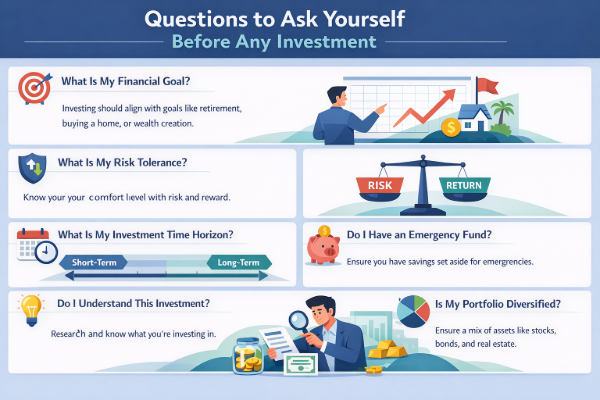
1. What Is the Purpose of This Investment?
This is the single most important question to ask before investing, and yet it is the one most people skip entirely. Purpose gives your investment a job to do. Without a clear financial goal, you are essentially putting money into something and hoping for the best.
Ask yourself: Is this money going towards buying a home in five years? Is it for your child’s college education? Are you building a retirement corpus, or are you simply trying to grow wealth over the long term?
When an investment is tied to a specific financial goal, you automatically know how much to invest, where to invest it, and for how long to stay invested. Without that clarity, even a solid investment can feel confusing and stressful.
2. What Is My Investment Time Horizon?
Your investment time horizon is simply how long you are willing to keep your money parked before you need it back. And honestly, this one question changes everything about what you should invest in.
If you need the money within the next one to three years say for a vacation, a car, or an emergency buffer you cannot afford to be in volatile equity markets. You need stability. On the flip side, if you are investing for retirement that is twenty years away, putting everything in fixed deposits is a slow-motion wealth killer.
As a general framework, short-term goals fall within zero to three years, medium-term goals sit between three and five years, and long-term goals stretch beyond five years. These are the benchmarks used by SEBI and AMFI in India, and they exist for good reason the right investment instrument changes significantly across each of these windows.
A longer investment time horizon works in your favor because of compounding your returns earn returns over time. But that only works if you stay invested. Knowing your horizon helps you choose the right investment and, just as importantly, helps you resist the urge to exit too early.
3. How Much Risk Can I Handle?
Risk tolerance is one of the most talked about concepts in personal finance, and also one of the most misunderstood. It is not just about how much loss you can mathematically absorb. It is about how you behave when your portfolio drops 20% in two weeks.
Ask yourself honestly: Would a temporary drop in value cause you to panic and sell? Can you stay calm during market volatility, or does the uncertainty keep you up at night? These are not signs of weakness they are just your real risk profile, and every investment decision should respect that.
Choosing investments that match your actual risk tolerance not the risk tolerance you wish you had is what keeps you disciplined when things get rough. An investment that earns 15% annually means nothing if you exit in a panic during a market correction.
4. Do I Have an Emergency Fund?
Before you put a single rupee into any investment, ask this question without exception. An emergency fund is not optional. It is the financial safety net that protects your investments from being broken into.
Most financial advisors recommend keeping three to six months of essential living expenses in a liquid, easily accessible account. If your income is irregular, or you have dependents or significant responsibilities, push that to six to twelve months.
Here is why this matters so much: without an emergency fund, a sudden job loss or medical expense will force you to liquidate your investments often at the worst possible time. Your portfolio should never be your emergency plan.
5. Do I Clearly Understand the Investment?
Warren Buffett famously champions one foundational rule: never invest in something you do not understand. It sounds obvious, but the number of people who invest in complex financial products they cannot explain in plain language is staggering.
Before putting money anywhere, you should be able to clearly answer: How does this investment generate returns? What risks am I actually taking on? What is the ideal time to stay invested, and what could go wrong?
If the person selling you the investment cannot explain it in simple terms or worse, makes it sound deliberately complicated that alone is a reason to walk away. Complexity is not sophistication. Clarity is.
6. What Are the Costs and Taxes Involved?
Returns get all the headlines, but costs and taxes quietly eat into your actual gains. Before investing, dig into the real numbers: expense ratios on mutual funds, brokerage charges, exit loads for early withdrawal, and capital gains tax implications.
Here is a real-world example of why this matters. A mutual fund with a 2% annual expense ratio versus a fund with a 0.5% expense ratio that 1.5% gap compounds silently over decades and can result in lakhs of rupees less in your final corpus. Even a modest investor doing a ₹5,000 monthly SIP over 20 years can end up losing over ₹10 lakhs to this difference alone. The gap is invisible year to year but devastating over a long investment horizon.
Always calculate your net returns after costs and taxes. It is net gain that builds wealth, not gross return.
7. How Does This Investment Fit Into My Overall Portfolio?
No investment exists in isolation. Every new addition either strengthens or weakens the balance of your overall portfolio. Before investing, step back and look at what you already hold.
Are you already heavily concentrated in one sector, one asset class, or one geography? Does this new investment improve your diversification, or does it just add more of the same risk you already have? A well-balanced portfolio typically spreads across equities for long-term growth, debt instruments for stability, and liquid assets for short-term needs.
Diversification is not about owning many things it is about owning the right mix of uncorrelated assets so that when one part of your portfolio dips, another holds steady.
8. What Is My Exit Strategy?
Most investors obsess over the entry point when to buy. Far fewer think about when and how they will exit. This is a costly blind spot.
Before you invest, ask: When will I need this money, and what will trigger my exit? Is there a lock-in period I need to be aware of? Will I sell when I hit a specific return target, or when I reach my goal? What if markets fall at what point do I review versus exit?
Having a clear exit strategy protects you from two very common emotional traps panic-selling during a market downturn, and holding on too long out of greed when your goal has already been met. Plan the exit before you enter.
9. Am I Investing Based on My Plan or Following the Crowd?
This might be the most emotionally charged question on this list, because following the crowd feels safe. If everyone is buying into something, surely it must be a good investment right? That thinking has cost a lot of people a lot of money.
When an investment becomes the hottest topic at dinner parties and in WhatsApp groups, you are often looking at a market already priced for perfection. The people who made money likely got in much earlier.
Before jumping in, ask: Does this investment genuinely fit my financial goals and risk profile? Or am I simply reacting to noise and fear of missing out? A personal investment plan is your filter. Use it every time.
10. Does This Investment Support My Overall Financial Plan?
This final question ties everything together. Investing is not a standalone activity. It is one piece of a much larger financial plan that includes your income, monthly expenses, insurance coverage, tax planning, and retirement goals.
An investment that makes sense on paper but leaves you underinsured, over-leveraged, or tax-inefficient is not actually a good investment for your situation. Every financial decision you make should fit into the bigger picture you are building.
When investments are aligned with your complete financial plan, they become intentional and purposeful not just bets you are placing and hoping will work out.
Final Thoughts
Investing well is not about chasing the highest return. It is about making thoughtful, well-considered decisions that are aligned with where you are in life and where you want to go.
The ten questions above are not meant to overwhelm you or create analysis paralysis. They are a simple framework to slow you down just enough to avoid the kind of impulsive investment decisions that set people back financially for years.
Go through them every single time you consider a new investment whether it is your first or your fiftieth. The questions to ask before investing do not change. What changes is how confident and clear your answers become over time.
Smart investing starts not with a market tip, but with honest, purposeful self-reflection. Ask the right questions first. The right investments tend to follow naturally.
FAQs
Why should I ask questions before investing?
Asking questions helps you understand whether an investment fits your financial goals, risk tolerance, and time horizon. This reduces the chances of making impulsive decisions.
How much emergency fund should I have before investing?
Most financial planners recommend keeping at least 3–6 months of essential living expenses, while people with unstable income may consider 6–12 months for additional security.
Is it safe to invest without understanding the investment?
Why are investment costs important?
Costs such as fund fees, brokerage, and taxes can reduce overall returns, especially over long periods due to the impact of compounding.